2019B AMC 12 真题(P版)
中英双语:每题先中文,后附英文原题;解答在同页下方「查看答案解析与下载」里。
1
Alicia 有两个容器。第一个装了 \(\dfrac{5}{6}\) 容积的水,第二个是空的。她把第一个容器中的水全部倒入第二个容器,此时第二个容器装了 \(\dfrac{3}{4}\) 容积的水。第一个容器的体积与第二个容器的体积之比是多少?
A\(\dfrac{5}{8}\) B\(\dfrac{4}{5}\) C\(\dfrac{7}{8}\) D\(\dfrac{9}{10}\) E\(\dfrac{11}{12}\)
English
Alicia had two containers. The first was \(\dfrac{5}{6}\) full of water and the second was empty. She poured all the water from the first container into the second container, at which point the second container was \(\dfrac{3}{4}\) full of water. What is the ratio of the volume of the first container to the volume of the second container?
(A) \(\dfrac{5}{8}\)(B) \(\dfrac{4}{5}\)(C) \(\dfrac{7}{8}\)(D) \(\dfrac{9}{10}\)(E) \(\dfrac{11}{12}\)
2
考虑命题:“如果 \(n\) 不是质数,那么 \(n-2\) 是质数。”下列哪个 \(n\) 的值是这个命题的反例?
A\(11\) B\(15\) C\(19\) D\(21\) E\(27\)
English
Consider the statement, “If \(n\) is not prime, then \(n-2\) is prime.” Which of the following values of \(n\) is a counterexample to this statement?
(A) \(11\)(B) \(15\)(C) \(19\)(D) \(21\)(E) \(27\)
3
下列哪个刚性变换(等距变换)把线段 \(\overline{AB}\) 映到线段 \(\overline{A'B'}\),使得 \(A(-2,1)\) 的像是 \(A'(2,-1)\),且 \(B(-1,4)\) 的像是 \(B'(1,-4)\)?
A关于 \(y\)-轴反射 B绕原点逆时针旋转 \(90^\circ\) C向右平移 \(3\) 个单位并向下平移 \(5\) 个单位 D关于 \(x\)-轴反射 E绕原点顺时针旋转 \(180^\circ\)
English
Which one of the following rigid transformations (isometries) maps the line segment \(\overline{AB}\) onto the line segment \(\overline{A'B'}\) so that the image of \(A(-2,1)\) is \(A'(2,-1)\) and the image of \(B(-1,4)\) is \(B'(1,-4)?\)
(A) reflection in the \(y\)-axis(B) counterclockwise rotation around the origin by \(90^\circ\)(C) translation by \(3\) units to the right and \(5\) units down(D) reflection in the \(x\)-axis(E) clockwise rotation about the origin by \(180^\circ\)
4
正整数 \(n\) 满足方程 \((n+1)!+(n+2)!=440\cdot n!\)。\(n\) 的各位数字之和是多少?
A\(2\) B\(5\) C\(10\) D\(12\) E\(15\)
English
A positive integer \(n\) satisfies the equation \((n+1)!+(n+2)!=440\cdot n!.\) What is the sum of the digits of \(n?\)
(A) \(2\)(B) \(5\)(C) \(10\)(D) \(12\)(E) \(15\)
5
一家商店中每块糖果的价格都是整数美分。Casper 的钱刚好可以买 \(12\) 块红色糖果,或 \(14\) 块绿色糖果,或 \(15\) 块蓝色糖果,或 \(n\) 块紫色糖果。一块紫色糖果价格为 \(20\) 美分。\(n\) 的最小可能值是多少?
A\(18\) B\(21\) C\(24\) D\(25\) E\(28\)
English
Each piece of candy in a store costs a whole number of cents. Casper has exactly enough money to buy either \(12\) pieces of red candy, \(14\) pieces of green candy, \(15\) pieces of blue candy, or \(n\) pieces of purple candy. A piece of purple candy costs \(20\) cents. What is the smallest possible value of \(n?\)
(A) \(18\)(B) \(21\)(C) \(24\)(D) \(25\)(E) \(28\)
6
在一个给定平面中,点 \(A\) 和 \(B\) 相距 \(10\) 个单位。平面中有多少个点 \(C\),使得 \(\triangle ABC\) 的周长为 \(50\) 个单位,且 \(\triangle ABC\) 的面积为 \(100\) 平方单位?
A\(0\) B\(2\) C\(4\) D\(8\) E无穷多个
English
In a given plane, points \(A\) and \(B\) are \(10\) units apart. How many points \(C\) are there in the plane such that the perimeter of \(\triangle ABC\) is \(50\) units and the area of \(\triangle ABC\) is \(100\) square units?
(A) \(0\)(B) \(2\)(C) \(4\)(D) \(8\)(E) infinitely many
7
使 \(4\),\(6\),\(8\),\(17\) 和 \(x\) 这五个数的中位数等于平均数的所有实数 \(x\) 的和是多少?
A\(-5\) B\(0\) C\(5\) D\(\dfrac{15}{4}\) E\(\dfrac{35}{4}\)
English
What is the sum of all real numbers \(x\) for which the median of the numbers \(4,\) \(6,\) \(8,\) \(17,\) and \(x\) is equal to the mean of those five numbers?
(A) \(-5\)(B) \(0\)(C) \(5\)(D) \(\dfrac{15}{4}\)(E) \(\dfrac{35}{4}\)
8
令 \(f(x)=x^2(1-x)^2\)。求下列和的值:
\[ \begin{gathered} f\!\left(\tfrac{1}{2019}\right)-f\!\left(\tfrac{2}{2019}\right) \\ {}+f\!\left(\tfrac{3}{2019}\right)-f\!\left(\tfrac{4}{2019}\right) \\ {}+\cdots+f\!\left(\tfrac{2017}{2019}\right) \\ {}-f\!\left(\tfrac{2018}{2019}\right) \end{gathered}\text{?}\]
A\(0\) B\(\dfrac{1}{2019^4}\) C\(\dfrac{2018^2}{2019^4}\) D\(\dfrac{2020^2}{2019^4}\) E\(1\)
English
Let \(f(x)=x^2(1-x)^2.\) What is the value of the sum
\[ \begin{gathered} f\!\left(\tfrac{1}{2019}\right)-f\!\left(\tfrac{2}{2019}\right) \\ {}+f\!\left(\tfrac{3}{2019}\right)-f\!\left(\tfrac{4}{2019}\right) \\ {}+\cdots+f\!\left(\tfrac{2017}{2019}\right) \\ {}-f\!\left(\tfrac{2018}{2019}\right)? \end{gathered} \]
(A) \(0\)(B) \(\dfrac{1}{2019^4}\)(C) \(\dfrac{2018^2}{2019^4}\)(D) \(\dfrac{2020^2}{2019^4}\)(E) \(1\)
9
有多少个整数 \(x\),使得边长为 \(\log_2 x\)、\(\log_4 x\) 和 \(3\) 的三角形面积为正?
A\(57\) B\(59\) C\(61\) D\(62\) E\(63\)
English
For how many integral values of \(x\) can a triangle of positive area be formed having side lengths \(\log_2 x,\) \(\log_4 x,\) and \(3?\)
(A) \(57\)(B) \(59\)(C) \(61\)(D) \(62\)(E) \(63\)
10
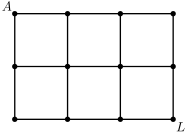
下图是一张地图,显示 \(12\) 座城市和连接某些城市对的 \(17\) 条道路。Paula 想从城市 \(A\) 出发,到城市 \(L\) 结束,恰好走过其中 \(13\) 条道路,且任何一段道路都不能走超过一次。(Paula 可以多次到访同一座城市。)Paula 有多少条不同路线可以选择?
A\(0\) B\(1\) C\(2\) D\(3\) E\(4\)
English
The figure below is a map showing \(12\) cities and \(17\) roads connecting certain pairs of cities. Paula wishes to travel along exactly \(13\) of those roads, starting at city \(A\) and ending at city \(L,\) without traveling along any portion of a road more than once. (Paula is allowed to visit a city more than once.) How many different routes can Paula take?
(A) \(0\)(B) \(1\)(C) \(2\)(D) \(3\)(E) \(4\)
11
给定一个立方体,有多少对无序的棱可以确定一个平面?
A\(12\) B\(28\) C\(36\) D\(42\) E\(66\)
English
How many unordered pairs of edges of a given cube determine a plane?
(A) \(12\)(B) \(28\)(C) \(36\)(D) \(42\)(E) \(66\)
12
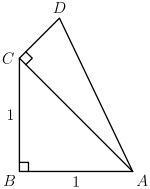
如图,等腰直角三角形 \(ABC\) 的直角边长为 \(1\)。在其斜边 \(\overline{AC}\) 上向外作直角三角形 \(ACD\),其直角在 \(C\),且两个三角形的周长相等。\(\sin(2\angle BAD)\) 是多少?
A\(\dfrac{1}{3}\) B\(\dfrac{\sqrt2}{2}\) C\(\dfrac{3}{4}\) D\(\dfrac{7}{9}\) E\(\dfrac{\sqrt3}{2}\)
English
Right triangle \(ACD\) with right angle at \(C\) is constructed outwards on the hypotenuse \(\overline{AC}\) of isosceles right triangle \(ABC\) with leg length \(1,\) as shown, so that the two triangles have equal perimeters. What is \(\sin(2\angle BAD)?\)
(A) \(\dfrac{1}{3}\)(B) \(\dfrac{\sqrt2}{2}\)(C) \(\dfrac{3}{4}\)(D) \(\dfrac{7}{9}\)(E) \(\dfrac{\sqrt3}{2}\)
13
一个红球和一个绿球随机且独立地被投入编号为正整数的箱子中。对每个球来说,投进第 \(k\) 号箱子的概率为 \(2^{-k}\),其中 \(k=1\),\(2\),\(3\),\(\ldots\)。红球被投入编号比绿球更大的箱子的概率是多少?
A\(\dfrac{1}{4}\) B\(\dfrac{2}{7}\) C\(\dfrac{1}{3}\) D\(\dfrac{3}{8}\) E\(\dfrac{3}{7}\)
English
A red ball and a green ball are randomly and independently tossed into bins numbered with the positive integers so that for each ball, the probability that it is tossed into bin \(k\) is \(2^{-k}\) for \(k=1,\) \(2,\) \(3,\) \(\ldots\) What is the probability that the red ball is tossed into a higher-numbered bin than the green ball?
(A) \(\dfrac{1}{4}\)(B) \(\dfrac{2}{7}\)(C) \(\dfrac{1}{3}\)(D) \(\dfrac{3}{8}\)(E) \(\dfrac{3}{7}\)
14
设 \(S\) 为 \(100{,}000\) 的所有正整数因数组成的集合。有多少个数可以表示为 \(S\) 中两个不同元素的乘积?
A\(98\) B\(100\) C\(117\) D\(119\) E\(121\)
English
Let \(S\) be the set of all positive integer divisors of \(100{,}000.\) How many numbers are the product of two distinct elements of \(S?\)
(A) \(98\)(B) \(100\)(C) \(117\)(D) \(119\)(E) \(121\)
15
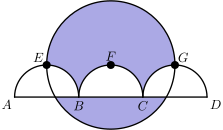
如图,线段 \(\overline{AD}\) 被点 \(B\) 和 \(C\) 三等分,使得 \(AB=BC=CD=2\)。三个半径为 \(1\) 的半圆 \(AEB\),\(BFC\),和 \(CGD\) 的直径都在 \(\overline{AD}\) 上,并分别在 \(E\),\(F\),和 \(G\) 处与直线 \(EG\) 相切。一个半径为 \(2\) 的圆以 \(F\) 为圆心。图中阴影区域,即在该圆内但在三个半圆外的区域,其面积可表示为
\[ \dfrac{a}{b}\cdot\pi-\sqrt{c}+d\text{,}\]
其中 \(a\),\(b\),\(c\),和 \(d\) 为正整数,且 \(a\) 与 \(b\) 互质。\(a+b+c+d\) 是多少?
A\(13\) B\(14\) C\(15\) D\(16\) E\(17\)
English
As shown in the figure, line segment \(\overline{AD}\) is trisected by points \(B\) and \(C\) so that \(AB=BC=CD=2.\) Three semicircles of radius \(1,\) \(AEB,\) \(BFC,\) and \(CGD,\) have their diameters on \(\overline{AD},\) and are tangent to line \(EG\) at \(E,\) \(F,\) and \(G,\) respectively. A circle of radius \(2\) has its center on \(F.\) The area of the region inside the circle but outside the three semicircles, shaded in the figure, can be expressed in the form
\[ \dfrac{a}{b}\cdot\pi-\sqrt{c}+d, \]
where \(a,\) \(b,\) \(c,\) and \(d\) are positive integers and \(a\) and \(b\) are relatively prime. What is \(a+b+c+d?\)
(A) \(13\)(B) \(14\)(C) \(15\)(D) \(16\)(E) \(17\)
16
一排睡莲叶依次编号为 \(0\) 到 \(11\)。第 \(3\) 号和第 \(6\) 号睡莲叶上有捕食者,第 \(10\) 号睡莲叶上有一小块食物。青蛙 Fiona 从第 \(0\) 号睡莲叶出发;从任意一片睡莲叶出发,她有 \(\dfrac12\) 的概率跳到下一片,也有同样的概率向前跳 \(2\) 片。Fiona 不落在第 \(3\) 号或第 \(6\) 号睡莲叶上而到达第 \(10\) 号的概率是多少?
A\(\dfrac{15}{256}\) B\(\dfrac{1}{16}\) C\(\dfrac{15}{128}\) D\(\dfrac{1}{8}\) E\(\dfrac{1}{4}\)
English
There are lily pads in a row numbered \(0\) to \(11,\) in that order. There are predators on lily pads \(3\) and \(6,\) and a morsel of food on lily pad \(10.\) Fiona the frog starts on pad \(0,\) and from any given lily pad, has a \(\dfrac12\) chance to hop to the next pad, and an equal chance to jump \(2\) pads. What is the probability that Fiona reaches pad \(10\) without landing on either pad \(3\) or pad \(6?\)
(A) \(\dfrac{15}{256}\)(B) \(\dfrac{1}{16}\)(C) \(\dfrac{15}{128}\)(D) \(\dfrac{1}{8}\)(E) \(\dfrac{1}{4}\)
17
有多少个非零复数 \(z\) 满足:在复平面中,\(0\)、\(z\)、\(z^3\) 所表示的点是一个等边三角形的三个不同顶点?
A\(0\) B\(1\) C\(2\) D\(4\) E无穷多个
English
How many nonzero complex numbers \(z\) have the property that \(0,\) \(z,\) and \(z^3,\) when represented by points in the complex plane, are the three distinct vertices of an equilateral triangle?
(A) \(0\)(B) \(1\)(C) \(2\)(D) \(4\)(E) infinitely many
18
四棱锥 \(ABCDE\) 的底面 \(ABCD\) 是边长为 \(3\) cm 的正方形,高 \(\overline{AE}\) 垂直于底面且长为 \(6\) cm。点 \(P\) 在 \(\overline{BE}\) 上从 \(B\) 到 \(E\) 的三分之一处;点 \(Q\) 在 \(\overline{DE}\) 上从 \(D\) 到 \(E\) 的三分之一处;点 \(R\) 在 \(\overline{CE}\) 上从 \(C\) 到 \(E\) 的三分之二处。\(\triangle PQR\) 的面积是多少平方厘米?
A\(\dfrac{3\sqrt2}{2}\) B\(\dfrac{3\sqrt3}{2}\) C\(2\sqrt2\) D\(2\sqrt3\) E\(3\sqrt2\)
English
Square pyramid \(ABCDE\) has base \(ABCD,\) which measures \(3\) cm on a side, and altitude \(\overline{AE}\) perpendicular to the base, which measures \(6\) cm. Point \(P\) lies on \(\overline{BE},\) one third of the way from \(B\) to \(E;\) point \(Q\) lies on \(\overline{DE},\) one third of the way from \(D\) to \(E;\) and point \(R\) lies on \(\overline{CE},\) two thirds of the way from \(C\) to \(E.\) What is the area, in square centimeters, of \(\triangle PQR?\)
(A) \(\dfrac{3\sqrt2}{2}\)(B) \(\dfrac{3\sqrt3}{2}\)(C) \(2\sqrt2\)(D) \(2\sqrt3\)(E) \(3\sqrt2\)
19
Raashan、Sylvia 和 Ted 玩下面的游戏。每人初始有 \(\$1\)。每隔 \(15\) 秒铃响一次,此时当前有钱的每个玩家 同时独立随机地选择另外两名玩家之一,并给该玩家 \(\$1\)。铃响 \(2019\) 次后,每个玩家都有 \(\$1\) 的概率是多少?(例如,Raashan 和 Ted 可以都决定给 Sylvia \(\$1\),而 Sylvia 可以决定把她的一美元给 Ted,这时 Raashan 有 \(\$0\),Sylvia 有 \(\$2\),Ted 有 \(\$1\),第一轮游戏结束。第二轮中 Raashan 没有钱可给,但 Sylvia 和 Ted 可能互相选择给对方 \(\$1\),则第二轮结束时持有金额不变。)
A\(\dfrac{1}{7}\) B\(\dfrac{1}{4}\) C\(\dfrac{1}{3}\) D\(\dfrac{1}{2}\) E\(\dfrac{2}{3}\)
English
Raashan, Sylvia, and Ted play the following game. Each starts with \(\$1.\) A bell rings every \(15\) seconds, at which time each of the players who currently have money simultaneously chooses one of the other two players independently and at random and gives \(\$1\) to that player. What is the probability that after the bell has rung \(2019\) times, each player will have \(\$1?\) (For example, Raashan and Ted may each decide to give \(\$1\) to Sylvia, and Sylvia may decide to give her dollar to Ted, at which point Raashan will have \(\$0,\) Sylvia will have \(\$2,\) and Ted will have \(\$1,\) and that is the end of the first round of play. In the second round Raashan has no money to give, but Sylvia and Ted might choose each other to give their \(\$1\) to, and the holdings will be the same at the end of the second round.)
(A) \(\dfrac{1}{7}\)(B) \(\dfrac{1}{4}\)(C) \(\dfrac{1}{3}\)(D) \(\dfrac{1}{2}\)(E) \(\dfrac{2}{3}\)
20
点 \(A(6,13)\) 和 \(B(12,11)\) 在平面中的圆 \(\omega\) 上。假设 \(\omega\) 在 \(A\) 和 \(B\) 处的切线相交于 \(x\)-轴上的一点。\(\omega\) 的面积是多少?
A\(\dfrac{83\pi}{8}\) B\(\dfrac{21\pi}{2}\) C\(\dfrac{85\pi}{8}\) D\(\dfrac{43\pi}{4}\) E\(\dfrac{87\pi}{8}\)
English
Points \(A(6,13)\) and \(B(12,11)\) lie on circle \(\omega\) in the plane. Suppose that the tangent lines to \(\omega\) at \(A\) and \(B\) intersect at a point on the \(x\)-axis. What is the area of \(\omega?\)
(A) \(\dfrac{83\pi}{8}\)(B) \(\dfrac{21\pi}{2}\)(C) \(\dfrac{85\pi}{8}\)(D) \(\dfrac{43\pi}{4}\)(E) \(\dfrac{87\pi}{8}\)
21
有多少个实系数二次多项式满足:根的集合等于系数的集合?(说明:若多项式为 \(ax^2+bx+c\),\(a\neq0\),根为 \(r\) 和 \(s\),则要求 \(\{a,b,c\}=\{r,s\}\)。)
A\(3\) B\(4\) C\(5\) D\(6\) E无穷多个
English
How many quadratic polynomials with real coefficients are there such that the set of roots equals the set of coefficients? (For clarification: If the polynomial is \(ax^2+bx+c,\) \(a\neq0,\) and the roots are \(r\) and \(s,\) then the requirement is that \(\{a,b,c\}=\{r,s\}.\))
(A) \(3\)(B) \(4\)(C) \(5\)(D) \(6\)(E) infinitely many
22
递归定义数列:\(x_0=5\),且
\[ x_{n+1}=\dfrac{x_n^2+5x_n+4}{x_n+6} \]
对所有非负整数 \(n\) 成立。设 \(m\) 为满足
\[ x_m\le4+\dfrac{1}{2^{20}}\text{。}\]
的最小正整数。\(m\) 位于下列哪个区间?
A\([9,26]\) B\([27,80]\) C\([81,242]\) D\([243,728]\) E\([729,\infty)\)
English
Define a sequence recursively by \(x_0=5\) and
\[ x_{n+1}=\dfrac{x_n^2+5x_n+4}{x_n+6} \]
for all nonnegative integers \(n.\) Let \(m\) be the least positive integer such that
\[ x_m\le4+\dfrac{1}{2^{20}}. \]
In which of the following intervals does \(m\) lie?
(A) \([9,26]\)(B) \([27,80]\)(C) \([81,242]\)(D) \([243,728]\)(E) \([729,\infty)\)
23
有多少个由 \(0\) 和 \(1\) 组成的长度为 \(19\) 的序列,满足以 \(0\) 开头、以 \(0\) 结尾、不含两个连续的 \(0\),且不含三个连续的 \(1\)?
A\(55\) B\(60\) C\(65\) D\(70\) E\(75\)
English
How many sequences of \(0\)s and \(1\)s of length \(19\) are there that begin with a \(0,\) end with a \(0,\) contain no two consecutive \(0\)s, and contain no three consecutive \(1\)s?
(A) \(55\)(B) \(60\)(C) \(65\)(D) \(70\)(E) \(75\)
24
令 \(\omega=-\dfrac12+\dfrac12 i\sqrt3\)。设 \(S\) 表示复平面中所有形如 \(a+b\omega+c\omega^2\) 的点,其中 \(0\le a\le1\),\(0\le b\le1\),且 \(0\le c\le1\)。\(S\) 的面积是多少?
A\(\dfrac12\sqrt3\) B\(\dfrac34\sqrt3\) C\(\dfrac32\sqrt3\) D\(\dfrac12\pi\sqrt3\) E\(\pi\)
English
Let \(\omega=-\dfrac12+\dfrac12 i\sqrt3.\) Let \(S\) denote all points in the complex plane of the form \(a+b\omega+c\omega^2,\) where \(0\le a\le1,\) \(0\le b\le1,\) and \(0\le c\le1.\) What is the area of \(S?\)
(A) \(\dfrac12\sqrt3\)(B) \(\dfrac34\sqrt3\)(C) \(\dfrac32\sqrt3\)(D) \(\dfrac12\pi\sqrt3\)(E) \(\pi\)
25
设 \(ABCD\) 是一个凸四边形,且 \(BC=2\)、\(CD=6\)。假设 \(\triangle ABC\),\(\triangle BCD\),和 \(\triangle ACD\) 的重心构成一个等边三角形的顶点。\(ABCD\) 的面积最大可能值是多少?
A\(27\) B\(16\sqrt3\) C\(12+10\sqrt3\) D\(9+12\sqrt3\) E\(30\)
English
Let \(ABCD\) be a convex quadrilateral with \(BC=2\) and \(CD=6.\) Suppose that the centroids of \(\triangle ABC,\) \(\triangle BCD,\) and \(\triangle ACD\) form the vertices of an equilateral triangle. What is the maximum possible value of the area of \(ABCD?\)
(A) \(27\)(B) \(16\sqrt3\)(C) \(12+10\sqrt3\)(D) \(9+12\sqrt3\)(E) \(30\)
查看答案解析与下载
答案速查
| 题号 | 1 | 2 | 3 | 4 | 5 | 6 | 7 | 8 | 9 |
| 答案 | D | E | E | C | B | A | A | A | B |
| 题号 | 10 | 11 | 12 | 13 | 14 | 15 | 16 | 17 | 18 |
| 答案 | E | D | D | C | C | E | A | D | C |
| 题号 | 19 | 20 | 21 | 22 | 23 | 24 | 25 |
| 答案 | B | C | B | C | C | C | C |
答案串:DEECBAAABEDDCCEADCBCBCCCC
逐题解析
1 答案 D
倒水前后水的体积相同,所以 \(\dfrac{5}{6}V_1=\dfrac{3}{4}V_2\)。
因此 \[ \dfrac{V_1}{V_2}=\dfrac{\frac{3}{4}}{\frac{5}{6}}=\dfrac{3}{4}\cdot\dfrac{6}{5}=\dfrac{9}{10}\text{。}\]
所以正确答案是 D。
English
The volume of water is the same before and after, so \(\dfrac{5}{6}V_1=\dfrac{3}{4}V_2.\)
Then \[ \dfrac{V_1}{V_2}=\dfrac{\frac{3}{4}}{\frac{5}{6}}=\dfrac{3}{4}\cdot\dfrac{6}{5}=\dfrac{9}{10}. \]
Thus, D is the correct answer.
2 答案 E
反例需要 \(n\) 不是质数(条件成立),且 \(n-2\) 不是质数(结论不成立)。
在选项中,\(27\) 不是质数,且 \(27-2=25\) 也不是质数。质数 \(11\) 和 \(19\) 不满足条件,而 \(15-2=13\),\(21-2=19\) 都是质数。
所以正确答案是 E。
English
A counterexample needs \(n\) not prime (so the hypothesis holds) and \(n-2\) not prime (so the conclusion fails).
Among the choices, \(27\) is not prime and \(27-2=25\) is not prime. The primes \(11\) and \(19\) fail the hypothesis, and \(15-2=13,\) \(21-2=19\) are prime.
Thus, E is the correct answer.
3 答案 E
每个点都按 \((x,y)\to(-x,-y)\) 映射:确实有 \((-2,1)\to(2,-1)\) 且 \((-1,4)\to(1,-4)\)。
映射 \((x,y)\to(-x,-y)\) 是绕原点旋转 \(180^\circ\)。
所以正确答案是 E。
English
Each point maps by \((x,y)\to(-x,-y):\) indeed \((-2,1)\to(2,-1)\) and \((-1,4)\to(1,-4).\)
The map \((x,y)\to(-x,-y)\) is a \(180^\circ\) rotation about the origin.
Thus, E is the correct answer.
4 答案 C
分解左边:\[ \begin{gathered} (n+1)!+(n+2)! \\ =(n+1)!\,[1+(n+2)] \\ =(n+1)!\,(n+3) \end{gathered}\text{。}\]
两边同除以 \(n!\) 并使用 \((n+1)!=(n+1)\,n!\) 得到 \[ (n+1)(n+3)=440\text{。}\]
所以 \(n^2+4n-437=0\),可分解为 \((n-19)(n+23)=0\),得 \(n=19\)。它的数字和为 \(1+9=10\)。
所以正确答案是 C。
English
Factor the left side: \[ \begin{gathered} (n+1)!+(n+2)! \\ =(n+1)!\,[1+(n+2)] \\ =(n+1)!\,(n+3). \end{gathered} \]
Dividing both sides by \(n!\) and using \((n+1)!=(n+1)\,n!\) gives \[ (n+1)(n+3)=440. \]
So \(n^2+4n-437=0,\) which factors as \((n-19)(n+23)=0,\) giving \(n=19.\) Its digit sum is \(1+9=10.\)
Thus, C is the correct answer.
5 答案 B
设 Casper 有 \(M\) 美分。因为他可以刚好买 \(12\)、\(14\) 或 \(15\) 块价格为整数美分的糖果,所以 \(M\) 是 \(\operatorname{lcm}(12,14,15)=420\) 的倍数。
紫色糖果每块 \(20\) 美分,所以 \(n=\dfrac{M}{20}\)。最小的 \(M\) 是 \(420\),得 \(n=\dfrac{420}{20}=21\)。
所以正确答案是 B。
English
Let \(M\) be Casper’s money in cents. Since he can exactly buy \(12,\) \(14,\) or \(15\) whole-cent pieces, \(M\) is a multiple of \(\operatorname{lcm}(12,14,15)=420.\)
Purple candy costs \(20\) cents, so \(n=\dfrac{M}{20}.\) The smallest \(M\) is \(420,\) giving \(n=\dfrac{420}{20}=21.\)
Thus, B is the correct answer.
6 答案 A
周长条件给出 \(CA+CB=50-10=40\),所以 \(C\) 在以 \(A,B\) 为焦点、长轴 \(2a=40\) 的椭圆上。因此 \(a=20\) 且 \(c=5\),所以半短轴为 \[ b=\sqrt{a^2-c^2}=\sqrt{375}\approx19.36\text{。}\]
若以 \(AB=10\) 为底且面积为 \(100\),则从 \(C\) 到底边的高必须为 \(\dfrac{2\cdot100}{10}=20\)。但椭圆上的最大可能高度是 \(b\approx19.36\lt20\),所以不存在这样的 \(C\)。
所以正确答案是 A。
English
The perimeter condition gives \(CA+CB=50-10=40,\) so \(C\) lies on an ellipse with foci \(A,B\) and major axis \(2a=40.\) Thus \(a=20\) and \(c=5,\) so the semi-minor axis is \[ b=\sqrt{a^2-c^2}=\sqrt{375}\approx19.36. \]
For area \(100\) with base \(AB=10,\) the height from \(C\) must be \(\dfrac{2\cdot100}{10}=20.\) But the greatest possible height on the ellipse is \(b\approx19.36\lt20,\) so no such \(C\) exists.
Thus, A is the correct answer.
7 答案 A
平均数为 \(\dfrac{4+6+8+17+x}{5}=\dfrac{35+x}{5}\)。
若 \(x\le6\),中位数是 \(6\),所以 \(\dfrac{35+x}{5}=6\),得 \(x=-5\),符合该范围。
若 \(6\lt x\lt8\),中位数是 \(x\),所以 \(\dfrac{35+x}{5}=x\),得 \(x=8.75\),不在范围内。若 \(x\ge8\),中位数是 \(8\),所以 \(\dfrac{35+x}{5}=8\),得 \(x=5\),不在范围内。
唯一解是 \(x=-5\),因此和为 \(-5\)。
所以正确答案是 A。
English
The mean is \(\dfrac{4+6+8+17+x}{5}=\dfrac{35+x}{5}.\)
If \(x\le6,\) the median is \(6,\) so \(\dfrac{35+x}{5}=6\) gives \(x=-5,\) which is consistent.
If \(6\lt x\lt8,\) the median is \(x,\) so \(\dfrac{35+x}{5}=x\) gives \(x=8.75,\) not in range. If \(x\ge8,\) the median is \(8,\) so \(\dfrac{35+x}{5}=8\) gives \(x=5,\) not in range.
The only solution is \(x=-5,\) so the sum is \(-5.\)
Thus, A is the correct answer.
8 答案 A
因为 \(f(1-x)=(1-x)^2x^2=f(x)\),所以 \(f\!\left(\tfrac{k}{2019}\right)=f\!\left(\tfrac{2019-k}{2019}\right)\)。
在这个和中,指标为 \(k\) 的项符号是 \((-1)^{k+1}\),而指标为 \(2019-k\) 的项数值相等,但符号是 \((-1)^{2019-k+1}=(-1)^{k}\),恰好相反。
每一项都与它的配对项抵消,所以总和为 \(0\)。
所以正确答案是 A。
English
Since \(f(1-x)=(1-x)^2x^2=f(x),\) we have \(f\!\left(\tfrac{k}{2019}\right)=f\!\left(\tfrac{2019-k}{2019}\right).\)
In the sum, the term with index \(k\) has sign \((-1)^{k+1},\) while the term with index \(2019-k\) equals it in value but has sign \((-1)^{2019-k+1}=(-1)^{k},\) the opposite.
Every term cancels with its partner, so the total is \(0.\)
Thus, A is the correct answer.
9 答案 B
令 \(t=\log_2 x\),则 \(\log_4 x=\dfrac{t}{2}\),三边为 \(t,\ \dfrac{t}{2},\ 3\)。
三角形不等式给出 \(t+\dfrac{t}{2}\gt3\)(所以 \(t\gt2\))以及 \(\dfrac{t}{2}+3\gt t\)(所以 \(t\lt6\));第三个不等式自动成立。
因此 \(2\lt\log_2 x\lt6\),即 \(4\lt x\lt64\)。整数 \(5,6,\ldots,63\) 共有 \(59\) 个。
所以正确答案是 B。
English
Let \(t=\log_2 x.\) Then \(\log_4 x=\dfrac{t}{2},\) and the sides are \(t,\ \dfrac{t}{2},\ 3.\)
The triangle inequalities give \(t+\dfrac{t}{2}\gt3\) (so \(t\gt2\)) and \(\dfrac{t}{2}+3\gt t\) (so \(t\lt6\)); the third inequality is automatic.
Thus \(2\lt\log_2 x\lt6,\) i.e. \(4\lt x\lt64.\) The integers \(5,6,\ldots,63\) number \(59.\)
Thus, B is the correct answer.
10 答案 E
将上排四座城市依次命名为 \(A,B,C,D\),中排为 \(E,F,G,H\),下排为 \(I,J,K,L\)。一条使用 \(13\) 条道路的路线是一条开放欧拉迹,所以在所用道路构成的图中,只有 \(A\) 和 \(L\) 的度数为奇数。
在完整地图中,需要改变度数奇偶性的顶点是 \(A,B,C,E,H,J,K,L\)。因为只删除 \(4\) 条道路,这四条道路必须将这 \(8\) 个顶点两两配对。其中 \(E\) 只与 \(A\) 相邻,所以必须删除 \(AE\);随后 \(BC\) 也被迫删除。同理,\(H\) 只与 \(L\) 相邻,所以必须删除 \(HL\),随后删除 \(JK\)。
剩余图是一条链 \[ \begin{gathered} A-B-F,\\ F-E-I-J-F,\\ F-G,\\ G-C-D-H-G,\\ G-K-L \end{gathered}\text{。}\]两个 \(4\) 边形环各可沿两个方向遍历,其余部分都被迫确定。因此共有 \(2\cdot2=4\) 条路线。
所以 E 是正确答案。
English
Name the four cities in the top row \(A,B,C,D,\) those in the middle row \(E,F,G,H,\) and those in the bottom row \(I,J,K,L.\) A route using \(13\) roads is an open Euler trail, so in the used graph exactly \(A\) and \(L\) have odd degree.
In the full map, the vertices whose degree parity must change are \(A,B,C,E,H,J,K,L.\) Because only \(4\) roads are removed, those roads must pair these \(8\) vertices. Among them, \(E\) is adjacent only to \(A,\) forcing \(AE\) to be removed; then \(BC\) is forced. Similarly \(H\) is adjacent only to \(L,\) forcing \(HL,\) and then \(JK.\)
The remaining graph is a chain \[ \begin{gathered} A-B-F,\\ F-E-I-J-F,\\ F-G,\\ G-C-D-H-G,\\ G-K-L. \end{gathered} \] Each of the two \(4\)-cycles can be traversed in either direction, and everything else is forced. Hence there are \(2\cdot2=4\) routes.
Thus, E is the correct answer.
11 答案 D
两条棱恰好在共面时能确定一个平面,也就是它们平行或相交。
\(12\) 条棱分成 \(3\) 个方向,每个方向有 \(4\) 条平行棱,得到 \(3\binom{4}{2}=18\) 对平行棱。共顶点的棱对有 \(8\binom{3}{2}=24\) 对。
总数为 \(18+24=42\)。
所以正确答案是 D。
English
Two edges determine a plane exactly when they are coplanar, that is, parallel or intersecting.
The \(12\) edges split into \(3\) directions of \(4\) parallel edges, giving \(3\binom{4}{2}=18\) parallel pairs. Edges sharing a vertex give \(8\binom{3}{2}=24\) intersecting pairs.
The total is \(18+24=42.\)
Thus, D is the correct answer.
12 答案 D
三角形 \(ABC\) 的周长为 \(1+1+\sqrt2=2+\sqrt2\),且 \(AC=\sqrt2\)。在 \(\triangle ACD\) 中设 \(CD=d\),则 \(AD=\sqrt{2+d^2}\),周长相等给出 \[ \sqrt2+d+\sqrt{2+d^2}=2+\sqrt2\text{。}\]
因此 \(\sqrt{2+d^2}=2-d\),所以 \(2+d^2=4-4d+d^2\),得 \(d=\dfrac12\) 且 \(AD=\dfrac32\)。
因为 \(\angle BAC=45^\circ\),令 \(\theta=\angle CAD\) 则 \(2\angle BAD=90^\circ+2\theta\),所以 \(\sin(2\angle BAD)=\cos 2\theta\)。又 \(\tan\theta=\dfrac{CD}{AC}=\dfrac{1}{2\sqrt2}\),因此 \[ \begin{gathered} \cos2\theta=\dfrac{1-\tan^2\theta}{1+\tan^2\theta} \\ =\dfrac{1-\tfrac18}{1+\tfrac18}=\dfrac{7}{9} \end{gathered}\text{。}\]
所以正确答案是 D。
English
Triangle \(ABC\) has perimeter \(1+1+\sqrt2=2+\sqrt2\) and \(AC=\sqrt2.\) In \(\triangle ACD\) let \(CD=d,\) so \(AD=\sqrt{2+d^2}\) and equal perimeters give \[ \sqrt2+d+\sqrt{2+d^2}=2+\sqrt2. \]
Then \(\sqrt{2+d^2}=2-d,\) so \(2+d^2=4-4d+d^2,\) giving \(d=\dfrac12\) and \(AD=\dfrac32.\)
Since \(\angle BAC=45^\circ,\) writing \(\theta=\angle CAD\) gives \(2\angle BAD=90^\circ+2\theta,\) so \(\sin(2\angle BAD)=\cos 2\theta.\) With \(\tan\theta=\dfrac{CD}{AC}=\dfrac{1}{2\sqrt2},\) we get \[ \begin{gathered} \cos2\theta=\dfrac{1-\tan^2\theta}{1+\tan^2\theta} \\ =\dfrac{1-\tfrac18}{1+\tfrac18}=\dfrac{7}{9}. \end{gathered} \]
Thus, D is the correct answer.
13 答案 C
两球落入同一箱子的概率为 \[ \begin{gathered} \sum_{k=1}^\infty \left(2^{-k}\right)^2=\sum_{k=1}^\infty 4^{-k} \\ =\dfrac{\frac{1}{4}}{1-\frac{1}{4}}=\dfrac13 \end{gathered}\text{。}\]
由对称性,红球编号更大和绿球编号更大的概率相等,所以各自概率为 \[ \dfrac{1-\tfrac13}{2}=\dfrac13\text{。}\]
所以正确答案是 C。
English
The probability the balls land in the same bin is \[ \begin{gathered} \sum_{k=1}^\infty \left(2^{-k}\right)^2=\sum_{k=1}^\infty 4^{-k} \\ =\dfrac{\frac{1}{4}}{1-\frac{1}{4}}=\dfrac13. \end{gathered} \]
By symmetry, the red ball being higher and the green ball being higher are equally likely, so each has probability \[ \dfrac{1-\tfrac13}{2}=\dfrac13. \]
Thus, C is the correct answer.
14 答案 C
因为 \(100{,}000=2^5\cdot5^5\),每个因数都形如 \(2^a5^b\),其中 \(0\le a,b\le5\)。两个因数的乘积形如 \(2^x5^y\),其中 \(0\le x,y\le10\),且每个这样的 \((x,y)\) 都能达到,得到 \(11\cdot11=121\) 个值。
我们需要两个不同的因数。一个值 \(2^x5^y\) 只能表示为某个因数乘以自身,恰好发生在 \(x\) 和 \(y\) 都只有一种拆分方式时,也就是 \(x,y\in\{0,10\}\)。这 \(4\) 个角上的值(\(1,\ 2^{10},\ 5^{10},\ 2^{10}5^{10}\))不能使用两个不同因数表示。
数量为 \(121-4=117\)。
所以正确答案是 C。
English
Since \(100{,}000=2^5\cdot5^5,\) every divisor is \(2^a5^b\) with \(0\le a,b\le5.\) A product of two divisors is \(2^x5^y\) with \(0\le x,y\le10,\) and every such pair \((x,y)\) is attainable, giving \(11\cdot11=121\) values.
We need two distinct divisors. A value \(2^x5^y\) is forced to be a divisor times itself only when both \(x\) and \(y\) have a unique split, which happens exactly when \(x,y\in\{0,10\}.\) Those \(4\) corner values (\(1,\ 2^{10},\ 5^{10},\ 2^{10}5^{10}\)) cannot use two distinct divisors.
The count is \(121-4=117.\)
Thus, C is the correct answer.
15 答案 E
设 \(A=(0,0)\),\(\ B=(2,0)\),\(\ C=(4,0)\),\(\ D=(6,0)\),则三个半圆的圆心为 \((1,0),(3,0),(5,0)\),顶点为 \(E=(1,1)\),\(\ F=(3,1)\),\(\ G=(5,1)\)。该圆的圆心为 \(F=(3,1)\),半径为 \(2\),所以它经过 \(E\) 和 \(G\),面积为 \(4\pi\)。
中间半圆 \(BFC\) 完全落在该圆内,去掉面积 \(\dfrac{\pi}{2}\)。对于左边的半圆,重叠部分从 \(E\) 开始,包含它右侧的四分之一圆,但要除去落在大圆下方的那块区域。大圆与 \(x\) 轴相交于 \(x=3-\sqrt3\)。被除去的面积为\[ \begin{aligned} I &=\int_1^{3-\sqrt3}1\,dx\\ &\quad-\int_1^{3-\sqrt3} \sqrt{4-(x-3)^2}\,dx\\ &=2-\dfrac{\sqrt3}{2}-\dfrac{\pi}{3} \end{aligned}\text{。}\] 因此重叠部分的面积为\[ \begin{aligned} R&=\dfrac{\pi}{4}-I\\ &=\dfrac{7\pi}{12}-2+\dfrac{\sqrt3}{2} \end{aligned}\text{。}\] 由对称性,右边的半圆贡献同样大的重叠面积。
阴影面积为\[ 4\pi-\dfrac{\pi}{2}-2R=\dfrac{7}{3}\pi-\sqrt3+4\text{。}\] 因此 \(a=7,\ b=3,\ c=3,\ d=4\),所以 \(a+b+c+d=17\)。
所以正确答案是 E。
English
Put \(A=(0,0),\) \(\ B=(2,0),\) \(\ C=(4,0),\) \(\ D=(6,0),\) so the semicircles are centered at \((1,0),(3,0),(5,0)\) and their tops are \(E=(1,1),\) \(\ F=(3,1),\) \(\ G=(5,1).\) The circle has center \(F=(3,1)\) and radius \(2,\) so it passes through \(E\) and \(G,\) and has area \(4\pi.\)
The middle semicircle \(BFC\) lies entirely inside the circle, removing area \(\dfrac{\pi}{2}.\) For the left semicircle, the overlap starts at \(E\) and includes its right-hand quarter-circle, except for the region below the large circle. The large circle meets the \(x\)-axis at \(x=3-\sqrt3.\) The excluded area is \[ \begin{aligned} I &=\int_1^{3-\sqrt3}1\,dx\\ &\quad-\int_1^{3-\sqrt3} \sqrt{4-(x-3)^2}\,dx\\ &=2-\dfrac{\sqrt3}{2}-\dfrac{\pi}{3}. \end{aligned} \] Therefore the overlap has area \[ \begin{aligned} R&=\dfrac{\pi}{4}-I\\ &=\dfrac{7\pi}{12}-2+\dfrac{\sqrt3}{2}. \end{aligned} \] By symmetry, the right semicircle contributes the same overlap.
The shaded area is \[ 4\pi-\dfrac{\pi}{2}-2R=\dfrac{7}{3}\pi-\sqrt3+4. \] Hence \(a=7,\ b=3,\ c=3,\ d=4,\) so \(a+b+c+d=17.\)
Thus, E is the correct answer.
16 答案 A
设 \(p(n)\) 为在之前没有落到第 \(3\) 号或第 \(6\) 号的情况下落到第 \(n\) 号睡莲叶的概率。每片睡莲叶把概率 \(\dfrac12\) 传到下一片,另一个 \(\dfrac12\) 传到再下一片,而第 \(3\) 号和第 \(6\) 号不再向外传递概率。
因此 \(p(0)=1,\ p(1)=\dfrac12,\ p(2)=\dfrac34\),并且(跳过 \(3\)) \(p(4)=\dfrac38,\ p(5)=\dfrac{3}{16}\),然后(跳过 \(6\)) \(p(7)=\dfrac{3}{32}\),\(\ p(8)=\dfrac{3}{64}\),\(\ p(9)=\dfrac{9}{128}\)。
最后 \[ \begin{gathered} p(10)=\dfrac12 p(8)+\dfrac12 p(9) \\ =\dfrac{3}{128}+\dfrac{9}{256} \\ =\dfrac{15}{256} \end{gathered}\text{。}\]
所以正确答案是 A。
English
Let \(p(n)\) be the probability of landing on pad \(n\) without first landing on pad \(3\) or \(6.\) Each pad sends probability \(\dfrac12\) to the next pad and \(\dfrac12\) two pads ahead, and pads \(3\) and \(6\) pass nothing on.
Then \(p(0)=1,\ p(1)=\dfrac12,\ p(2)=\dfrac34,\) and (skipping \(3\)) \(p(4)=\dfrac38,\ p(5)=\dfrac{3}{16},\) then (skipping \(6\)) \(p(7)=\dfrac{3}{32},\) \(\ p(8)=\dfrac{3}{64},\) \(\ p(9)=\dfrac{9}{128}.\)
Finally \[ \begin{gathered} p(10)=\dfrac12 p(8)+\dfrac12 p(9) \\ =\dfrac{3}{128}+\dfrac{9}{256} \\ =\dfrac{15}{256}. \end{gathered} \]
Thus, A is the correct answer.
17 答案 D
这三个点构成等边三角形,当且仅当 \(|z|=|z^3|=|z^3-z|\)。由 \(|z|=|z^3|=|z|^3\) 得 \(|z|=1\)。
于是 \(|z^3-z|=|z|\,|z^2-1|=|z^2-1|\),所以需要 \(|z^2-1|=1\)。写 \(z=e^{i\theta}\),则 \(|z^2-1|=2|\sin\theta|=1\),所以 \(|\sin\theta|=\dfrac12\)。
因此 \(\theta=30^\circ,150^\circ,210^\circ,330^\circ\),给出四个 \(z\) 的值,并且所得顶点互不相同。
所以正确答案是 D。
English
The three points form an equilateral triangle iff \(|z|=|z^3|=|z^3-z|.\) From \(|z|=|z^3|=|z|^3\) we get \(|z|=1.\)
Then \(|z^3-z|=|z|\,|z^2-1|=|z^2-1|,\) so we need \(|z^2-1|=1.\) Writing \(z=e^{i\theta},\) \(|z^2-1|=2|\sin\theta|=1,\) so \(|\sin\theta|=\dfrac12.\)
This gives \(\theta=30^\circ,150^\circ,210^\circ,330^\circ,\) four values of \(z,\) all yielding distinct vertices.
Thus, D is the correct answer.
18 答案 C
取 \(A=(0,0,0)\),\(\ B=(3,0,0)\),\(\ C=(3,3,0)\),\(\ D=(0,3,0)\),\(\ E=(0,0,6)\)。则 \[ \begin{gathered} P=(2,0,2), \\ Q=(0,2,2), \\ R=(1,1,4) \end{gathered}\text{。}\]
所以 \(\vec{PQ}=(-2,2,0)\),\(\vec{PR}=(-1,1,2)\),从而 \(\vec{PQ}\times\vec{PR}=(4,4,0)\)。
面积为 \(\dfrac12\bigl|(4,4,0)\bigr|=\dfrac12\cdot4\sqrt2=2\sqrt2\)。
所以正确答案是 C。
English
Place \(A=(0,0,0),\) \(\ B=(3,0,0),\) \(\ C=(3,3,0),\) \(\ D=(0,3,0),\) \(\ E=(0,0,6).\) Then \[ \begin{gathered} P=(2,0,2), \\ Q=(0,2,2), \\ R=(1,1,4). \end{gathered} \]
So \(\vec{PQ}=(-2,2,0)\) and \(\vec{PR}=(-1,1,2),\) giving \(\vec{PQ}\times\vec{PR}=(4,4,0).\)
The area is \(\dfrac12\bigl|(4,4,0)\bigr|=\dfrac12\cdot4\sqrt2=2\sqrt2.\)
Thus, C is the correct answer.
19 答案 B
从 \((1,1,1)\) 出发,三名玩家各自把钱给另外两人之一,所以有 \(8\) 个等可能结果;只有 \(2\) 种循环赠送模式会回到 \((1,1,1)\),概率为 \(\dfrac14\)。
从 \((2,1,0)\) 状态出发,没钱的玩家不给钱;检查另外两人的 \(4\) 个等可能选择,恰好一个会得到 \((1,1,1)\),概率仍为 \(\dfrac14\)。
因此任意一次铃响后,状态为 \((1,1,1)\) 的概率都是 \(\dfrac14\),包括铃响 \(2019\) 次之后。
所以正确答案是 B。
English
From \((1,1,1),\) each of the three players gives to one of two others, so there are \(8\) equally likely outcomes; only the \(2\) cyclic gift patterns return to \((1,1,1),\) a probability of \(\dfrac14.\)
From a \((2,1,0)\) state the broke player gives nothing, and checking the \(4\) equally likely choices of the other two shows exactly one yields \((1,1,1),\) again probability \(\dfrac14.\)
So after any ring the probability of \((1,1,1)\) is \(\dfrac14,\) including after \(2019\) rings.
Thus, B is the correct answer.
20 答案 C
设切线交点为 \(P=(x,0)\)。相等切线长给出 \(PA=PB\),所以 \((x-6)^2+13^2\) \(=(x-12)^2+11^2\),得 \(x=5\),即 \(P=(5,0)\)。
圆心 \(O=(h,k)\) 满足 \(OA\perp PA\) 和 \(OB\perp PB\)。因为 \(PA=(1,13)\) 且 \(PB=(7,11)\),得到 \(h+13k=175\) 和 \(7h+11k=205\),所以 \(O=\left(\dfrac{37}{4},\dfrac{51}{4}\right)\)。
于是 \(r^2=OA^2\) \(=\left(\dfrac{13}{4}\right)^2+\left(\dfrac14\right)^2\) \(=\dfrac{170}{16}=\dfrac{85}{8}\),所以面积为 \(\dfrac{85\pi}{8}\)。
所以正确答案是 C。
English
Let \(P=(x,0)\) be the intersection. Equal tangent lengths give \(PA=PB,\) so \((x-6)^2+13^2\) \(=(x-12)^2+11^2,\) yielding \(x=5\) and \(P=(5,0).\)
The center \(O=(h,k)\) satisfies \(OA\perp PA\) and \(OB\perp PB.\) With \(PA=(1,13)\) and \(PB=(7,11),\) these give \(h+13k=175\) and \(7h+11k=205,\) so \(O=\left(\dfrac{37}{4},\dfrac{51}{4}\right).\)
Then \(r^2=OA^2\) \(=\left(\dfrac{13}{4}\right)^2+\left(\dfrac14\right)^2\) \(=\dfrac{170}{16}=\dfrac{85}{8},\) so the area is \(\dfrac{85\pi}{8}.\)
Thus, C is the correct answer.
21 答案 B
如果三个系数都等于同一个值 \(u\),多项式就是 \(u(x^2+x+1)\),其根不等于 \(u\)。因此系数集合和根集合都有两个不同的值,所以恰有两个系数相同。由韦达定理,\(r+s=-\dfrac{b}{a}\) 且 \(rs=\dfrac{c}{a}\)。
先设 \(a=b=u\) 且 \(c=v\)。根为 \(u,v\),所以韦达定理给出 \(u+v=-1\) 且 \(uv=\frac{v}{u}\)。因而 \(v(u^2-1)=0\),得到 \(x^2+x-2\) 和 \(-x^2-x\)。
如果 \(b=c=v\) 且 \(a=u\),同一个乘积方程给出 \(v(u^2-1)=0\),而和的方程只留下 \(u=1,\ v=-\tfrac12\)。这给出 \(x^2-\tfrac12x-\tfrac12\)。
最后,如果 \(a=c=u\) 且 \(b=v\),乘积方程给出 \(uv=1\),所以 \(v=\frac{1}{u}\)。和的方程变为 \(u^3+u+1=0\)。这个严格递增的三次函数有唯一实根 \(u\),因此恰好再得到一个多项式 \(ux^2+\dfrac1u x+u\)。所以共有 \(4\) 个多项式。
所以 B 是正确答案。
English
If all three coefficients had one value \(u,\) the polynomial would be \(u(x^2+x+1),\) whose roots do not equal \(u.\) Thus the coefficient and root sets both have two distinct values, so exactly two coefficients coincide. By Vieta’s formulas, \(r+s=-\dfrac{b}{a}\) and \(rs=\dfrac{c}{a}.\)
First suppose \(a=b=u\) and \(c=v.\) The roots are \(u,v,\) so Vieta gives \(u+v=-1\) and \(uv=\frac{v}{u}.\) Hence \(v(u^2-1)=0,\) producing \(x^2+x-2\) and \(-x^2-x.\)
If \(b=c=v\) and \(a=u,\) the same product equation gives \(v(u^2-1)=0,\) while the sum equation leaves only \(u=1,\ v=-\tfrac12.\) This gives \(x^2-\tfrac12x-\tfrac12.\)
Finally, if \(a=c=u\) and \(b=v,\) the product equation gives \(uv=1,\) so \(v=\frac{1}{u}.\) The sum equation becomes \(u^3+u+1=0.\) This strictly increasing cubic has one real root \(u,\) producing exactly one more polynomial, \(ux^2+\dfrac1u x+u.\) Therefore there are \(4\) polynomials.
Thus, B is the correct answer.
22 答案 C
令 \(a_n=x_n-4\)。简单计算得到 \[ \begin{gathered} a_{n+1}=x_{n+1}-4 \\ =\dfrac{(x_n+5)(x_n-4)}{x_n+6} \\ =a_n\cdot\dfrac{x_n+5}{x_n+6} \end{gathered}\text{。}\]
从 \(a_0=1\) 开始,各项保持为正并递减。因为 \(x_n\) 从 \(5\) 递减趋向 \(4\),每个比值 \(\dfrac{x_n+5}{x_n+6}\) 都严格介于 \(\dfrac{9}{10}\) 和 \(\dfrac{10}{11}\) 之间。
因此 \(a_m\) 被夹在 \(\left(\dfrac{9}{10}\right)^m\) 与 \(\left(\dfrac{10}{11}\right)^m\) 之间。求解 \(a_m\le2^{-20}\) 可知 \(m\) 大约在 \(132\) 到 \(146\) 之间,落在 \([81,242]\) 中。
所以正确答案是 C。
English
Let \(a_n=x_n-4.\) A short computation gives \[ \begin{gathered} a_{n+1}=x_{n+1}-4 \\ =\dfrac{(x_n+5)(x_n-4)}{x_n+6} \\ =a_n\cdot\dfrac{x_n+5}{x_n+6}. \end{gathered} \]
Starting from \(a_0=1,\) the terms stay positive and decrease. Because \(x_n\) decreases from \(5\) toward \(4,\) each ratio \(\dfrac{x_n+5}{x_n+6}\) lies strictly between \(\dfrac{9}{10}\) and \(\dfrac{10}{11}.\)
Hence \(a_m\) is squeezed between \(\left(\dfrac{9}{10}\right)^m\) and \(\left(\dfrac{10}{11}\right)^m.\) Solving \(a_m\le2^{-20}\) puts \(m\) between about \(132\) and \(146,\) which lies in \([81,242].\)
Thus, C is the correct answer.
23 答案 C
没有两个 \(0\) 相邻,所以 \(0\) 之间由若干 \(1\) 的块隔开,每块大小为 \(1\) 或 \(2\) (不能为 \(3\))。若有 \(k\) 个零,则有 \(k-1\) 个这样的块,合计 \(19-k\) 个一。
大小为 \(2\) 的块数为 \((19-k)-(k-1)=20-2k\),它必须满足 \(0\le20-2k\le k-1\),即 \(7\le k\le10\)。
对 \(k=7,8,9,10\) 求和 \(\binom{k-1}{20-2k}\) 得到 \(\binom66+\binom74+\binom82+\binom90\) \(=1+35+28+1\) \(=65\)。
所以正确答案是 C。
English
No two \(0\)s are adjacent, so the \(0\)s are separated by blocks of \(1\)s, each of size \(1\) or \(2\) (never \(3\)). If there are \(k\) zeros, there are \(k-1\) such blocks summing to \(19-k\) ones.
The number of size-\(2\) blocks is \((19-k)-(k-1)=20-2k,\) which must satisfy \(0\le20-2k\le k-1,\) i.e. \(7\le k\le10.\)
Summing \(\binom{k-1}{20-2k}\) over \(k=7,8,9,10\) gives \(\binom66+\binom74+\binom82+\binom90\) \(=1+35+28+1\) \(=65.\)
Thus, C is the correct answer.
24 答案 C
当 \(a,b,c\) 在 \([0,1]\) 中变化时,集合 \(S\) 是沿向量 \(v_1=1=(1,0)\),\(\ v_2=\omega=\left(-\dfrac12,\dfrac{\sqrt3}{2}\right)\),\(\ v_3=\omega^2=\left(-\dfrac12,-\dfrac{\sqrt3}{2}\right)\) 的三个单位线段的闵可夫斯基和。
这是一个带状多边形,其面积等于所有向量对的叉积大小之和。每一对都给出 \(|v_i\times v_j|=\dfrac{\sqrt3}{2}\)。
因此面积为 \(3\cdot\dfrac{\sqrt3}{2}=\dfrac{3\sqrt3}{2}\)。
所以正确答案是 C。
English
As \(a,b,c\) range over \([0,1],\) the set \(S\) is the Minkowski sum of the three unit segments along \(v_1=1=(1,0),\) \(\ v_2=\omega=\left(-\dfrac12,\dfrac{\sqrt3}{2}\right),\) \(\ v_3=\omega^2=\left(-\dfrac12,-\dfrac{\sqrt3}{2}\right).\)
This is a zonogon whose area is the sum of the cross-product magnitudes over pairs. Each pair gives \(|v_i\times v_j|=\dfrac{\sqrt3}{2}.\)
Therefore the area is \(3\cdot\dfrac{\sqrt3}{2}=\dfrac{3\sqrt3}{2}.\)
Thus, C is the correct answer.
25 答案 C
三个重心分别为 \(\dfrac{A+B+C}{3}\),\(\ \dfrac{B+C+D}{3}\),\(\ \dfrac{A+C+D}{3}\)。它们两两之差为 \(\dfrac{A-D}{3},\ \dfrac{B-A}{3},\ \dfrac{B-D}{3}\),所以重心三角形为等边三角形迫使 \(AB=BD=DA\);也就是说,\(\triangle ABD\) 是边长为 \(s=BD\) 的等边三角形。
沿 \(BD\) 分割,\[ \begin{gathered} [ABCD]=[ABD]+[BCD] \\ =\dfrac{\sqrt3}{4}s^2 \\ {}+\dfrac12\cdot2\cdot6\sin C \end{gathered}\text{,}\]其中 \(C=\angle BCD\)。由余弦定理,\(s^2=40-24\cos C\),所以 \[ \begin{gathered} [ABCD]=10\sqrt3 \\ {}-6\sqrt3\cos C+6\sin C \end{gathered}\text{。}\]
表达式 \(6\sin C-6\sqrt3\cos C\) 的最大值为 \(\sqrt{6^2+(6\sqrt3)^2}=12\),所以最大面积是 \(10\sqrt3+12=12+10\sqrt3\)。当 \(C=150^\circ\) 时取等号;构造具有这个角的 \(\triangle BCD\),并在 \(\overline{BD}\) 另一侧作等边 \(\triangle ABD\),可以得到凸四边形,所以最大值能够达到。
所以 C 是正确答案。
English
The centroids are \(\dfrac{A+B+C}{3},\) \(\ \dfrac{B+C+D}{3},\) \(\ \dfrac{A+C+D}{3}.\) Their pairwise differences are \(\dfrac{A-D}{3},\ \dfrac{B-A}{3},\ \dfrac{B-D}{3},\) so an equilateral centroid triangle forces \(AB=BD=DA;\) that is, \(\triangle ABD\) is equilateral with side \(s=BD.\)
Splitting along \(BD,\) \[ \begin{gathered} [ABCD]=[ABD]+[BCD] \\ =\dfrac{\sqrt3}{4}s^2 \\ {}+\dfrac12\cdot2\cdot6\sin C, \end{gathered} \] where \(C=\angle BCD.\) By the Law of Cosines \(s^2=40-24\cos C,\) so \[ \begin{gathered} [ABCD]=10\sqrt3 \\ {}-6\sqrt3\cos C+6\sin C. \end{gathered} \]
The expression \(6\sin C-6\sqrt3\cos C\) has maximum \(\sqrt{6^2+(6\sqrt3)^2}=12,\) so the greatest area is \(10\sqrt3+12=12+10\sqrt3.\) Equality occurs at \(C=150^\circ;\) constructing \(\triangle BCD\) with that angle and placing equilateral \(\triangle ABD\) on the opposite side of \(\overline{BD}\) produces a convex quadrilateral, so the maximum is attainable.
Thus, C is the correct answer.