2025 年 AMC 8 真题(P版)
中英双语:每题先中文,后附英文原题;解答在同页下方「查看答案解析与下载」里。
1
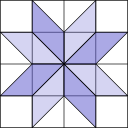
下图所示的八角星是一种流行的拼布图案。这个星形覆盖了整个 \(4\) 乘 \(4\) 网格的百分之多少?
A\(40\) B\(50\) C\(60\) D\(75\) E\(80\)
English
The eight-pointed star, shown in the figure below, is a popular quilting pattern. What percent of the entire \(4\)-by-\(4\) grid is covered by the star?
(A) \(40\)(B) \(50\)(C) \(60\)(D) \(75\)(E) \(80\)
2
下表显示了古埃及象形文字中表示不同数字的符号。
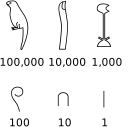
例如,数字 \(32\) 表示为:

下面这组象形文字表示什么数字?

A\(1{,}423\) B\(10{,}423\) C\(14{,}023\) D\(14{,}203\) E\(14{,}230\)
English
The table below shows the ancient Egyptian hieroglyphs that were used to represent different numbers.
For example, the number \(32\) was represented by:
What number was represented by the following combination of hieroglyphs?
(A) \(1{,}423\)(B) \(10{,}423\)(C) \(14{,}023\)(D) \(14{,}203\)(E) \(14{,}230\)
3
Buffalo Shuffle-o 是一种纸牌游戏,游戏开始时所有牌平均分给所有玩家。Annika 和她的 \(3\) 个朋友玩时,每位玩家分到 \(15\) 张牌。假设下一局又有 \(2\) 个朋友加入,每位玩家会分到多少张牌?
A\(8\) B\(9\) C\(10\) D\(11\) E\(12\)
English
Buffalo Shuffle-o is a card game in which all the cards are distributed evenly among all players at the start of the game. When Annika and \(3\) of her friends play Buffalo Shuffle-o, each player is dealt \(15\) cards. Suppose \(2\) more friends join the next game. How many cards will be dealt to each player?
(A) \(8\)(B) \(9\)(C) \(10\)(D) \(11\)(E) \(12\)
4
Lucius 正在每次减 \(7\) 倒着数。他的前三个数是 \(100\)、\(93\)、\(86\)。他的第 \(10\) 个数是多少?
A\(30\) B\(37\) C\(42\) D\(44\) E\(47\)
English
Lucius is counting backward by \(7\)s. His first three numbers are \(100,\) \(93,\) and \(86.\) What is his \(10\)th number?
(A) \(30\)(B) \(37\)(C) \(42\)(D) \(44\)(E) \(47\)
5
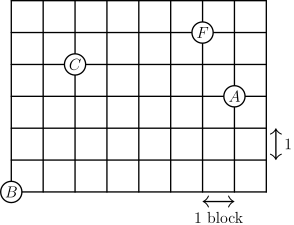
Betty 开卡车在一个街区送包裹,街道地图如下。Betty 从工厂(标为 \(F\))出发,依次开到地点 \(A\)、\(B\)、\(C\),然后回到 \(F\)。完成这条路线的最短距离是多少个街区?
A\(20\) B\(22\) C\(24\) D\(26\) E\(28\)
English
Betty drives a truck to deliver packages in a neighborhood whose street map is shown below. Betty starts at the factory (labeled \(F\)) and drives to location \(A,\) then \(B,\) then \(C,\) before returning to \(F.\) What is the shortest distance, in blocks, she can drive to complete the route?
(A) \(20\)(B) \(22\)(C) \(24\)(D) \(26\)(E) \(28\)
6
Sekou 写下 \(15\)、\(16\)、\(17\)、\(18\)、\(19\)。擦掉其中一个数后,剩下四个数的和是 \(4\) 的倍数。他擦掉了哪个数?
A\(15\) B\(16\) C\(17\) D\(18\) E\(19\)
English
Sekou writes the numbers \(15,\) \(16,\) \(17,\) \(18,\) \(19.\) After he erases one of the numbers, the sum of the remaining four numbers is a multiple of \(4.\) Which number did he erase?
(A) \(15\)(B) \(16\)(C) \(17\)(D) \(18\)(E) \(19\)
7
在 Xochi 教授班最近的一次考试中:
• \(5\) 名学生得分至少为 \(95\%\),
• \(13\) 名学生得分至少为 \(90\%\),
• \(27\) 名学生得分至少为 \(85\%\),
• \(50\) 名学生得分至少为 \(80\%\)。
有多少名学生得分至少为 \(80\%\) 且低于 \(90\%\)?
A\(8\) B\(14\) C\(22\) D\(37\) E\(45\)
English
On the most recent exam in Prof. Xochi’s class,
• \(5\) students earned a score of at least \(95\%,\)
• \(13\) students earned a score of at least \(90\%,\)
• \(27\) students earned a score of at least \(85\%,\) and
• \(50\) students earned a score of at least \(80\%.\)
How many students earned a score of at least \(80\%\) and less than \(90\%?\)
(A) \(8\)(B) \(14\)(C) \(22\)(D) \(37\)(E) \(45\)
8
Isaiah 沿一些边剪开一个纸板立方体,形成下图所示的平面图形,其面积为 \(18\) 平方厘米。原立方体的体积是多少立方厘米?

A\(3\sqrt{3}\) B\(6\) C\(9\) D\(6\sqrt{3}\) E\(9\sqrt{3}\)
English
Isaiah cuts open a cardboard cube along some of its edges to form the flat shape shown, which has an area of \(18\) square centimeters. What was the volume of the cube in cubic centimeters?
(A) \(3\sqrt{3}\)(B) \(6\)(C) \(9\)(D) \(6\sqrt{3}\)(E) \(9\sqrt{3}\)
9
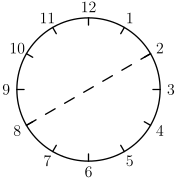
Ningli 看时钟上 \(6\) 对正对着的数字。她求每一对数字的平均数。所得 \(6\) 个数的平均数是多少?
A\(5\) B\(6.5\) C\(8\) D\(9.5\) E\(12\)
English
Ningli looks at the \(6\) pairs of numbers directly across from each other on a clock. She takes the average of each pair of numbers. What is the average of the resulting \(6\) numbers?
(A) \(5\)(B) \(6.5\)(C) \(8\)(D) \(9.5\)(E) \(12\)
10
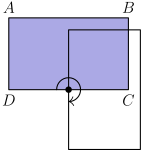
下图中,\(ABCD\) 是一个矩形,边长 \(AB = 5\) 英寸,\(AD = 3\) 英寸。矩形 \(ABCD\) 顺时针旋转 \(90^\circ\),旋转中心是边 \(DC\) 的中点,得到第二个矩形。两个重叠矩形覆盖的总面积是多少平方英寸?
A\(21\) B\(22.25\) C\(23\) D\(23.75\) E\(25\)
English
In the figure below, \(ABCD\) is a rectangle with sides of length \(AB = 5\) inches and \(AD = 3\) inches. Rectangle \(ABCD\) is rotated \(90^\circ\) clockwise around the midpoint of side \(DC\) to give a second rectangle. What is the total area, in square inches, covered by the two overlapping rectangles?
(A) \(21\)(B) \(22.25\)(C) \(23\)(D) \(23.75\)(E) \(25\)
11
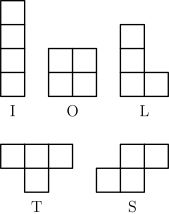
一个四格骨牌由四个沿边相连的正方形组成。可能的五种形状 \(\mathrm{I}\)、\(\mathrm{O}\)、\(\mathrm{L}\)、\(\mathrm{T}\)、\(\mathrm{S}\) 如下图所示,可以旋转或翻转。用三个四格骨牌完全覆盖一个 \(3 \times 4\) 矩形。至少有一块是 \(\mathrm{S}\) 形。另外两块是什么?
A\(\mathrm{I}\) 和 \(\mathrm{L}\) B\(\mathrm{I}\) 和 \(\mathrm{T}\) C\(\mathrm{L}\) 和 \(\mathrm{L}\) D\(\mathrm{L}\) 和 \(\mathrm{S}\) E\(\mathrm{O}\) 和 \(\mathrm{T}\)
English
A tetromino consists of four squares connected along their edges. There are five possible tetromino shapes, \(\mathrm{I}\), \(\mathrm{O}\), \(\mathrm{L}\), \(\mathrm{T}\), and \(\mathrm{S}\), shown below, which can be rotated or flipped over. Three tetrominoes are used to completely cover a \(3 \times 4\) rectangle. At least one of the tiles is an \(\mathrm{S}\) tile. What are the other two tiles?
(A) \(\mathrm{I}\) and \(\mathrm{L}\)(B) \(\mathrm{I}\) and \(\mathrm{T}\)(C) \(\mathrm{L}\) and \(\mathrm{L}\)(D) \(\mathrm{L}\) and \(\mathrm{S}\)(E) \(\mathrm{O}\) and \(\mathrm{T}\)
12
下图区域由 \(24\) 个边长为 \(1\) 厘米的正方形组成。能放入该区域内部、可以接触边界的最大圆的面积是多少平方厘米?

A\(3\pi\) B\(4\pi\) C\(5\pi\) D\(6\pi\) E\(8\pi\)
English
The region shown below consists of \(24\) squares, each with side length \(1\) centimeter. What is the area, in square centimeters, of the largest circle that can fit inside the region, possibly touching the boundaries?
(A) \(3\pi\)(B) \(4\pi\)(C) \(5\pi\)(D) \(6\pi\)(E) \(8\pi\)
13
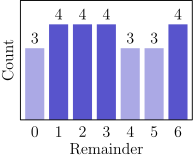
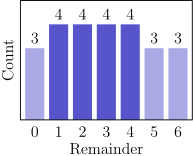
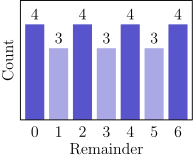
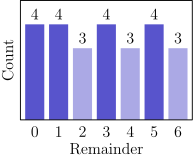
将所有偶数 \(2\)、\(4\)、\(6\)、\(\dots\)、\(50\) 分别除以 \(7\)。记录余数。哪一个直方图显示了每个余数出现的次数?
A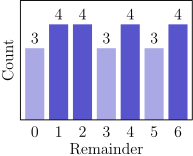 B
 C
 D
 E
English
Each of the even numbers \(2,\) \(4,\) \(6,\) \(\dots,\) \(50\) is divided by \(7.\) The remainders are recorded. Which histogram displays the number of times each remainder occurs?
(A) (B) (C) (D) (E)
14
一个数 \(N\) 被插入列表 \(2\)、\(6\)、\(7\)、\(7\)、\(28\) 中。现在平均数是中位数的两倍。\(N\) 是多少?
A\(7\) B\(14\) C\(20\) D\(28\) E\(34\)
English
A number \(N\) is inserted into the list \(2,\) \(6,\) \(7,\) \(7,\) \(28.\) The mean is now twice as great as the median. What is \(N?\)
(A) \(7\)(B) \(14\)(C) \(20\)(D) \(28\)(E) \(34\)
15
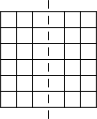
凯画了一个 \(6\) 乘 \(6\) 的网格。他把 \(13\) 个单位正方形涂成银色,其余涂成金色。然后凯沿竖直方向把网格对折,形成重叠的单位正方形对。设 \(m\) 和 \(M\) 分别为金色叠金色的对数的最小值和最大值。求 \(m+M\)。
A\(12\) B\(14\) C\(16\) D\(18\) E\(20\)
English
Kei draws a \(6\)-by-\(6\) grid. He colors \(13\) of the unit squares silver and the remaining squares gold. Kei then folds the grid in half vertically, forming pairs of overlapping unit squares. Let \(m\) and \(M\) equal the least and greatest possible number of gold-on-gold pairs, respectively. What is the value of \(m+M?\)
(A) \(12\)(B) \(14\)(C) \(16\)(D) \(18\)(E) \(20\)
16
从 \(1\) 到 \(10\) 中选出五个不同整数,并从 \(11\) 到 \(20\) 中选出五个不同整数。没有两个选出的数相差正好 \(10\)。这十个选出的数字之和是多少?
A\(95\) B\(100\) C\(105\) D\(110\) E\(115\)
English
Five distinct integers from \(1\) to \(10\) are chosen, and five distinct integers from \(11\) to \(20\) are chosen. No two numbers differ by exactly \(10.\) What is the sum of the ten chosen numbers?
(A) \(95\)(B) \(100\)(C) \(105\)(D) \(110\)(E) \(115\)
17
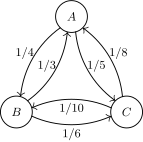
在马尔科维亚,有三座城市:\(A\)、\(B\)、\(C\)。住在 \(A\) 的有 \(100\) 人,住在 \(B\) 的有 \(120\) 人,住在 \(C\) 的有 \(160\) 人。每个人都在三座城市之一工作,也可以在自己居住的城市工作。下图中,从一座城市指向另一座城市的箭头标有居住在第一座城市且在第二座城市工作的人所占比例。(例如,住在 \(A\) 的人中有 \(\frac{1}{4}\) 在 \(B\) 工作。)有多少人在 \(A\) 工作?
A\(55\) B\(60\) C\(85\) D\(115\) E\(160\)
English
In the land of Markovia, there are three cities: \(A,\) \(B,\) and \(C.\) There are \(100\) people who live in \(A,\) \(120\) who live in \(B,\) and \(160\) who live in \(C.\) Everyone works in one of the three cities, and a person may work in the same city where they live. In the figure below, an arrow pointing from one city to another is labeled with the fraction of people living in the first city who work in the second city. (For example, \(\frac{1}{4}\) of the people who live in \(A\) work in \(B.\)) How many people work in \(A?\)
(A) \(55\)(B) \(60\)(C) \(85\)(D) \(115\)(E) \(160\)
18
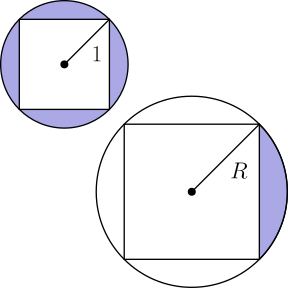
左图中的圆半径为 \(1\) 个单位。圆和内接正方形之间的区域被涂阴影。右图中的圆里,圆和内接正方形之间区域的四分之一被涂阴影。两圆中的阴影区域面积相同。右图圆的半径 \(R\) 是多少?
A\(\sqrt{2}\) B\(2\) C\(2\sqrt{2}\) D\(4\) E\(4\sqrt{2}\)
English
The circle shown below on the left has a radius of \(1\) unit. The region between the circle and the inscribed square is shaded. In the circle shown on the right, one quarter of the region between the circle and the inscribed square is shaded. The shaded regions in the two circles have the same area. What is the radius \(R,\) in units, of the circle on the right?
(A) \(\sqrt{2}\)(B) \(2\)(C) \(2\sqrt{2}\)(D) \(4\)(E) \(4\sqrt{2}\)
19
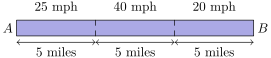
城镇 \(A\) 和 \(B\) 由一条长 \(15\) 英里的直路连接。从 \(A\) 到 \(B\) 行驶时,每 \(5\) 英里限速变化一次:从 \(25\) 到 \(40\) 再到 \(20\) 英里每小时。两辆车分别从 \(A\) 和 \(B\) 同时出发相向而行,并在每段路上都恰好按限速行驶。两车会在离城镇 \(A\) 多少英里处相遇?
A\(7.75\) B\(8\) C\(8.25\) D\(8.5\) E\(8.75\)
English
Two towns, \(A\) and \(B,\) are connected by a straight road, \(15\) miles long. Traveling from town \(A\) to town \(B,\) the speed limit changes every \(5\) miles: from \(25\) to \(40\) to \(20\) miles per hour (mph). Two cars, one at town \(A\) and one at town \(B,\) start moving toward each other at the same time. They drive at exactly the speed limit in each portion of the road. How far from town \(A,\) in miles, will the two cars meet?
(A) \(7.75\)(B) \(8\)(C) \(8.25\)(D) \(8.5\)(E) \(8.75\)
20
萨里卡、德夫和拉吉夫分享一大块奶酪。他们轮流切下剩余奶酪的一半并吃掉:先萨里卡吃掉一半,然后德夫吃掉剩余奶酪的一半,然后拉吉夫吃掉此时剩余奶酪的一半,接着又轮到萨里卡,以此类推。他们一直吃到奶酪小到看不见为止。萨里卡总共大约吃掉了原奶酪的几分之几?
A\(\dfrac{4}{7}\) B\(\dfrac{3}{5}\) C\(\dfrac{2}{3}\) D\(\dfrac{3}{4}\) E\(\dfrac{7}{8}\)
English
Sarika, Dev, and Rajiv are sharing a large block of cheese. They take turns cutting off half of what remains and eating it: first Sarika eats half of the cheese, then Dev eats half of the remaining half, then Rajiv eats half of what remains, then back to Sarika, and so on. They stop when the cheese is too small to see. About what fraction of the original block of cheese does Sarika eat in total?
(A) \(\dfrac{4}{7}\)(B) \(\dfrac{3}{5}\)(C) \(\dfrac{2}{3}\)(D) \(\dfrac{3}{4}\)(E) \(\dfrac{7}{8}\)
21
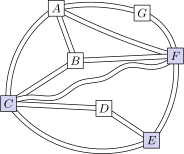
哥尼斯堡学校把 \(1\) 到 \(7\) 年级分别分配给 \(A\) 到 \(G\) 七个教学舱,每个教学舱一个年级。部分教学舱由步道连接,如下图所示。学校注意到每一对相连教学舱的年级差都至少为 \(2\) 个年级。(例如,\(1\) 年级和 \(2\) 年级不会在由步道直接相连的教学舱中。)分配给教学舱 \(C\)、\(E\)、\(F\) 的年级之和是多少?
A\(12\) B\(13\) C\(14\) D\(15\) E\(16\)
English
The Konigsberg School has assigned grades \(1\) through \(7\) to pods \(A\) through \(G,\) one grade per pod. Some of the pods are connected by walkways, as shown in the figure below. The school noticed that each pair of connected pods has been assigned grades differing by \(2\) or more grade levels. (For example, grades \(1\) and \(2\) will not be in pods directly connected by a walkway.) What is the sum of the grade levels assigned to pods \(C,\) \(E,\) and \(F?\)
(A) \(12\)(B) \(13\)(C) \(14\)(D) \(15\)(E) \(16\)
22
一个教室有一排 \(35\) 个挂衣钩。保利娜喜欢外套等距挂放,也就是说第一件外套前、最后一件外套后、以及每两件相邻外套之间的空钩数都相同。假设至少有 \(1\) 件外套,且至少有 \(1\) 个空钩。有多少种不同的外套数量能满足保利娜的排列方式?
A\(2\) B\(4\) C\(5\) D\(7\) E\(9\)
English
A classroom has a row of \(35\) coat hooks. Paulina likes coats to be equally spaced, so that there is the same number of empty hooks before the first coat, after the last coat, and between every coat and the next one. Suppose there is at least \(1\) coat and at least \(1\) empty hook. How many different numbers of coats can satisfy Paulina’s pattern?
(A) \(2\)(B) \(4\)(C) \(5\)(D) \(7\)(E) \(9\)
23
有多少个四位数同时满足以下三个性质?
(I) 十位数字和个位数字都是 \(9\)。
(II) 这个数比一个完全平方数小 \(1\)。
(III) 这个数是恰好两个质数的乘积。
A\(0\) B\(1\) C\(2\) D\(3\) E\(4\)
English
How many four-digit numbers have all three of the following properties?
(I) The tens digit and ones digit are both \(9.\)
(II) The number is \(1\) less than a perfect square.
(III) The number is the product of exactly two prime numbers.
(A) \(0\)(B) \(1\)(C) \(2\)(D) \(3\)(E) \(4\)
24
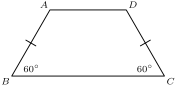
在梯形 \(ABCD\) 中,角 \(B\) 和角 \(C\) 都是 \(60^\circ\),且 \(AB = DC\)。所有边长都是正整数,梯形 \(ABCD\) 的周长为 \(30\) 个单位。有多少个互不全等的梯形满足这些条件?
A\(0\) B\(1\) C\(2\) D\(3\) E\(4\)
English
In trapezoid \(ABCD,\) angles \(B\) and \(C\) measure \(60^\circ\) and \(AB = DC.\) The side lengths are all positive integers and the perimeter of \(ABCD\) is \(30\) units. How many non-congruent trapezoids satisfy all of these conditions?
(A) \(0\)(B) \(1\)(C) \(2\)(D) \(3\)(E) \(4\)
25
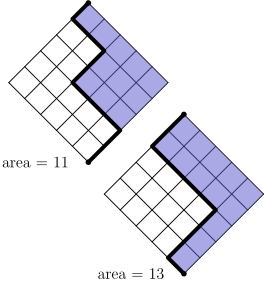
麦凯拉找出在一个 \(5 \times 5\) 菱形网格中画路径的所有可能方式。每条路径从网格底部开始,到顶部结束,每一步都向东北或西北移动一个单位。她计算每条路径与网格右边界之间区域的面积。下图给出了两个例子。所有可能路径确定的这些面积之和是多少?
A\(2520\) B\(3150\) C\(3840\) D\(4730\) E\(5050\)
English
Makayla finds all the possible ways to draw a path in a \(5 \times 5\) diamond-shaped grid. Each path starts at the bottom of the grid and ends at the top, always moving one unit northeast or northwest. She computes the area of the region between each path and the right side of the grid. Two examples are shown in the figures below. What is the sum of the areas determined by all possible paths?
(A) \(2520\)(B) \(3150\)(C) \(3840\)(D) \(4730\)(E) \(5050\)
查看答案解析与下载
答案速查
| 题号 | 1 | 2 | 3 | 4 | 5 | 6 | 7 | 8 | 9 |
| 答案 | B | B | C | B | C | C | D | A | B |
| 题号 | 10 | 11 | 12 | 13 | 14 | 15 | 16 | 17 | 18 |
| 答案 | D | C | C | A | E | C | C | D | B |
| 题号 | 19 | 20 | 21 | 22 | 23 | 24 | 25 |
| 答案 | D | A | A | D | B | E | B |
答案串:BBCBCCDABDCCAECCDBDAADBEB
逐题解析
1 答案 B
图形具有对称性,所以整个正方形中被星形覆盖的比例,等于任意一个四分之一区域中被覆盖的比例。
只看左上四分之一区域。设想把其中一个三角形平移一下:题目中的阴影面积与下图中的阴影面积完全相同(下图中左上四分之一用粗线标出):
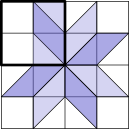
这样就能一眼看出左上四分之一区域恰好有一半被涂上阴影,所以答案是 \(50\%\),即选项 B。
English
There is symmetry, and so whatever fraction of the top-left quarter is shaded, is the same as the fraction of the entire square that is shaded.
Focus on the top-left quarter. Consider moving a single triangle. The shaded area in the problem is exactly the same as the shaded area in this diagram (and the top-left quarter is outlined in bold):
But then it is obvious that exactly half of the top-left quarter is shaded, and so the answer is \(50\%,\) which is choice B.
2 答案 B
只需数出每种符号各有多少个。
有 \(1\) 个表示 \(10{,}000\) 的符号。
有 \(4\) 个表示 \(100\) 的符号。
有 \(2\) 个表示 \(10\) 的符号。
有 \(3\) 个表示 \(1\) 的符号。
所以答案是 \(10{,}423\),即 B。
English
We just need to count how many of each type of glyph there are.
There is \(1\) glyph worth \(10{,}000.\)
There are \(4\) glyphs worth \(100\) each.
There are \(2\) glyphs worth \(10\) each.
There are \(3\) glyphs worth \(1\) each.
So, the answer is \(10{,}423,\) which is choice B.
3 答案 C
起初共有 \(4\) 人(Annika 和 \(3\) 个朋友),每人 \(15\) 张牌,所以总牌数为 \(4 \times 15 = 60\)。如果又有 \(2\) 个朋友加入,共有 \(6\) 人,因此每人分到 \(60 \div 6 = 10\) 张牌,选 C。
English
At the start, there are \(4\) total people (Annika plus \(3\) friends), each with \(15\) cards, so there are \(4 \times 15 = 60\) cards in total. If \(2\) more friends join, there will be \(6\) people in total, and so each should get \(60 \div 6 = 10\) cards, which is choice C.
4 答案 B
从他的第一个数 \(100\) 到第 \(10\) 个数之间有 \(10 - 1 = 9\) 个间隔,每个间隔的大小都是 \(7\)。
因此总共减去 \(9 \times 7 = 63\),从 \(100\) 剩下 \(100 - 63 = 37\),选 B。
English
There will be \(10 - 1 = 9\) gaps between his first number \(100\) and his \(10\)th number. Each gap has size \(7.\)
So, he will subtract a total of \(9 \times 7 = 63\) from \(100,\) leaving an answer of \(100 - 63 = 37,\) which is choice B.
5 答案 C
关键是:若在街道网格中从坐标 \((x_1, y_1)\) 开到 \((x_2, y_2)\),最短距离为 \(|x_2 - x_1| + |y_2 - y_1|\)。这通常称为曼哈顿距离。它也等于两地之间的水平街区数加上竖直街区数。
从 \(F\) 到 \(A\) 的最短距离是 \(1 + 2 = 3\)。
从 \(A\) 到 \(B\) 的最短距离是 \(7 + 3 = 10\)。
从 \(B\) 到 \(C\) 的最短距离是 \(2 + 4 = 6\)。
从 \(C\) 到 \(F\) 的最短距离是 \(4 + 1 = 5\)。
相加得到 \(3 + 10 + 6 + 5 = 24\),选 C。
一个小捷径是注意,从 \(B\) 到 \(C\) 再到 \(F\) 时,经过 \(C\) 正好位于从 \(B\) 到 \(F\) 的某条最短路径上,所以甚至可以先忽略必须停在 \(C\) 的要求。
English
The key idea is that if driving from coordinates \((x_1, y_1)\) to \((x_2, y_2),\) then the shortest distance is \(|x_2 - x_1| + |y_2 - y_1|.\) This is often called the Manhattan distance. It is also equal to the number of horizontal blocks between the locations, plus the number of vertical blocks between the locations.
The shortest distance from \(F\) to \(A\) is then \(1 + 2 = 3.\)
The shortest distance from \(A\) to \(B\) is \(7 + 3 = 10.\)
The shortest distance from \(B\) to \(C\) is \(2 + 4 = 6.\)
The shortest distance from \(C\) to \(F\) is \(4 + 1 = 5.\)
Adding up all of these numbers, we get \(3 + 10 + 6 + 5 = 24,\) which is choice C.
One small possible shortcut for the solution is to notice that when going from \(B\) to \(C\) to \(F,\) the visit to \(C\) is conveniently along a shortest path from \(B\) to \(F\) anyway, so we can even remove the requirement to stop at \(C\) from the problem.
6 答案 C
这五个数除以 \(4\) 的余数分别为 \(3\)、\(0\)、\(1\)、\(2\)、\(3\)。因此五个数的总和模 \(4\) 与 \(3 + 0 + 1 + 2 + 3 = 9\) 相同,余数为 \(1\)(模 \(4\))。要擦掉一个数后使总和余 \(0\)(模 \(4\)),必须擦掉一个余数为 \(1\)(模 \(4\))的数,也就是 \(17\)。所以答案是 C。
English
The remainders of the five numbers after dividing by \(4\) are: \(3,\) \(0,\) \(1,\) \(2,\) and \(3.\) So, the sum of all five numbers modulo \(4\) is the same as \(3 + 0 + 1 + 2 + 3 = 9\) which has remainder \(1\) modulo \(4.\) Therefore, in order to erase a single number and get a sum that is \(0\) modulo \(4,\) we must erase the number which was \(1\) modulo \(4,\) which was \(17.\) Therefore, the answer is C.
7 答案 D
注意各档人数逐步增加,这是因为条件变得越来越宽。
要包括所有至少 \(80\%\) 的 \(50\) 名学生,但排除所有至少 \(90\%\) 的 \(13\) 名学生。因此答案是 \(50 - 13 = 37\),选 D。
English
Notice that the numbers of students in each category keep increasing, which makes sense because the categories are getting broader.
We want to include all \(50\) of the students who earned a score of at least \(80\%\) but exclude all \(13\) of the students who earned a score of at least \(90\%.\) So, the answer is \(50 - 13 = 37,\) which is choice D.
8 答案 A
展开图由 \(6\) 个正方形面组成,所以每个面的面积是 \(18 \div 6 = 3\)。立方体边长为 \(\sqrt{3}\)。体积为 \(\sqrt{3} \times \sqrt{3} \times \sqrt{3} = 3\sqrt{3}\)。正确答案是 A。
English
There are \(6\) squares, so each has area \(18 \div 6 = 3.\) Then the side length of the cube is \(\sqrt{3}.\) The volume is \(\sqrt{3} \times \sqrt{3} \times \sqrt{3} = 3\sqrt{3},\) which is choice A.
9 答案 B
答案等于全部 \(12\) 个数字的平均数。一般地,把一组数两两配对,先求每对平均,再求这些平均数的平均,结果仍是所有原数的平均。
例如看较小的 \(6\) 个数 \(a\)、\(b\)、\(c\)、\(d\)、\(e\)、\(f\)。这些成对平均数的平均为 \[ \frac{1}{3} \left( \frac{a+b}{2} + \frac{c+d}{2} + \frac{e+f}{2} \right)\text{,}\]化简后等于 \[ \frac{a+b+c+d+e+f}{6}\text{。}\]对 \(12\) 个数也同理。
由于这 \(12\) 个数字等差排列,平均数等于首尾两项的平均,即 \[ \frac{1+12}{2} = \frac{13}{2} = 6.5\text{,}\]所以选 B。
English
The answer is the same as the average of all \(12\) numbers. To understand why this is the case, it is actually generally true that if a whole bunch of numbers is split up into pairs, and each pair is averaged, and then all those pair-averages are averaged, the answer is the average of all the numbers.
To see why this is true, consider a smaller example of \(6\) numbers \(a,\) \(b,\) \(c,\) \(d,\) \(e,\) and \(f.\) The average of the pair-averages is: \[ \frac{1}{3} \left( \frac{a+b}{2} + \frac{c+d}{2} + \frac{e+f}{2} \right) \] and that is equal to \[ \frac{a+b+c+d+e+f}{6}. \] The same type of simplification happens with \(12\) numbers.
Since the \(12\) numbers are equally spaced (in an arithmetic progression), the answer is the same as the average of the first and last number, which is \[ \frac{1+12}{2} = \frac{13}{2} = 6.5, \] or choice B.
10 答案 D
最直接的方法是用容斥:把两个矩形的面积相加,再减去重叠的正方形面积。
每个矩形面积为 \(5 \times 3 = 15\)。
重叠部分是边长 \(2.5\) 的正方形,面积为 \(2.5^2 = 6.25\)。
因此总覆盖面积为 \(15 + 15 - 6.25 = 23.75\),选 D。
English
The easiest way to solve this problem is using the Inclusion-Exclusion formula. That is: add the areas of the two rectangles, and then subtract the overlapping (square) area.
Each rectangle has area \(5 \times 3 = 15.\)
Their overlap is a square that has side length \(2.5,\) and so its area is \(2.5^2 = 6.25.\)
Therefore, the total area is \(15 + 15 - 6.25 = 23.75,\) which is choice D.
11 答案 C
稍加尝试可以想到,把 \(\mathrm{S}\) 形四格骨牌放在不会挡住太多地方的位置,例如这样:

剩余区域正好可以分成两个 \(\mathrm{L}\) 形四格骨牌,所以正确答案是 C。
English
A little trial-and-error suggests placing the \(\mathrm{S}\) tetromino in a way that does not block too much, like this:
It is then easy to see that the remainder can be partitioned into two \(\mathrm{L}\) tetrominoes, and so the answer is C.
12 答案 C
离区域中心最近的边界角点,是图中位于这个圆上的 \(8\) 个点:

由勾股定理,每个点到中心的距离为 \[ \sqrt{1^2 + 2^2} = \sqrt{5}\text{。}\]所以圆面积为 \[ \pi (\sqrt{5})^2 = 5\pi\text{,}\]选 C。
English
The corners of the region which are closest to the center are the \(8\) points which lie on this circle:
By the Pythagorean Theorem, each of these points has this distance from the center: \[ \sqrt{1^2 + 2^2} = \sqrt{5}. \] The area of the circle is then \[ \pi (\sqrt{5})^2 = 5\pi, \] which is choice C.
13 答案 A
余数依次为 \(2\)、\(4\)、\(6\)、\(1\)、\(3\)、\(5\)、\(0\),然后循环。
所有选项都有 \(3\) 根高度为 \(3\) 的柱和 \(4\) 根高度为 \(4\) 的柱。
因此应选择较高的柱落在最先出现的余数上的直方图,也就是 \(2\)、\(4\)、\(6\)、\(1\)。这是选项 A。
English
The remainders go in order \(2,\) \(4,\) \(6,\) \(1,\) \(3,\) \(5,\) \(0,\) and then repeat.
All of the answer choices have \(3\) bars of height \(3\) and \(4\) bars of height \(4.\)
So, we should pick the answer choice where the taller bars are on the first remainders to appear in our order, which are \(2,\) \(4,\) \(6,\) and \(1.\) That is option A.
14 答案 E
插入 \(N\) 后共有 \(6\) 个数。个数为偶数,所以中位数是中间两个数的平均。
所有选项都至少为 \(7\),所以插入后中间两个数仍是 \(7\) 和 \(7\)。方便的是,无论选哪个选项,中位数都是 \(7\)。
平均数是中位数的两倍,即 \(2 \times 7 = 14\)。
要让 \(6\) 个数的平均数为 \(14\),总和必须为 \(6 \times 14 = 84\)。
原来 \(5\) 个数的和为 \[ 2 + 6 + 7 + 7 + 28 = 50\text{,}\]所以答案是 \(84 - 50 = 34\),选 E。
English
After inserting \(N\) into the list, there will be \(6\) total numbers. That is even, so the median will be the average of the middle two numbers.
All of the answer choices are at least \(7,\) so when they are inserted into the list, the middle two numbers will be \(7\) and \(7.\) It is convenient that the median will always be \(7,\) no matter which answer choice is picked.
The mean becomes twice the median, which is \(2 \times 7 = 14.\)
To have a total of \(6\) numbers with mean \(14,\) their sum must become \(6 \times 14 = 84.\)
The sum of the original \(5\) numbers is \[ 2 + 6 + 7 + 7 + 28 = 50, \] so the answer is \(84 - 50 = 34,\) which is choice E.
15 答案 C
金色方格数为 \[ 6 \times 6 - 13 = 36 - 13 = 23\text{。}\]折叠后,\(36\) 个方格形成 \(18\) 对重叠方格。
要让双金色对数最小,先把金色方格分散到所有对中。这用掉 \(18\) 个金色方格,剩下 \(23 - 18 = 5\) 个必须与已有金色方格重叠,所以 \(m = 5\)。
要让双金色对数最大,就尽量把 \(23\) 个金色方格两两配对。最多可形成 \(M = 11\) 对,并剩下 \(1\) 个金色方格,因为 \(23 \div 2\) 商 \(11\) 余 \(1\)。
答案是 \(m + M = 5 + 11 = 16\),选 C。
English
The number of gold squares is \[ 6 \times 6 - 13 = 36 - 13 = 23. \] The \(36\) total squares overlap as \(18\) pairs.
To minimize the number of pairs with two gold squares, the gold squares should first be spread out across all pairs. That uses up \(18\) of them. The remaining \(23 - 18 = 5\) gold squares double-up and create a total of \(m = 5\) gold-on-gold pairs.
To maximize the number of pairs with two gold squares, the \(23\) gold squares should first be paired up as much as possible. That can be done to create \(M = 11\) pairs, with \(1\) gold square left over, because \(23 \div 2\) is \(11\) with a remainder of \(1.\)
The answer is \(m + M = 5 + 11 = 16,\) which is choice C.
16 答案 C
把 \(1\) 到 \(10\) 的整数称为低位区间,把 \(11\) 到 \(20\) 的整数称为高位区间。
从低位区间选出的 \(5\) 个不同数字,会排除高位区间中比它们正好大 \(10\) 的数。高位区间只有 \(10\) 个数,所以还剩 \(10 - 5 = 5\) 个没有被排除。
我们必须从高位区间选 \(5\) 个不同数字,所以选中的高位区间数字正好就是未被排除的那些。它们各自比低位区间中一个未选数字大 \(10\)。
因此,选中的 \(5\) 个高位区间数字之和,比低位区间中 \(5\) 个未选数字之和正好多 \(5 \times 10 = 50\)。
所以这 \(10\) 个选中数字的总和等于 \(50\),再加上低位区间中选中和未选数字的总和 \(1 + 2 + \dots + 10\)。
从 \(1\) 到 \(10\) 的和是 \(\frac{10 (10+1)}{2} = 55\),所以答案是 \(50 + 55 = 105\),选 C。
English
Call the integers from \(1\) to \(10\) inclusive the lower range, and call the integers from \(11\) to \(20\) inclusive the higher range.
Each of the \(5\) distinct numbers chosen from the lower range blocks out the number in the higher range that is exactly \(10\) more than itself. There are only \(10\) numbers in the higher range, so there are only \(10 - 5 = 5\) numbers not yet blocked.
We need to choose \(5\) distinct numbers from the higher range, so the numbers chosen from the higher range are precisely those which are not yet blocked. They are each exactly \(10\) more than a not-chosen number in the lower range.
So, the sum of the \(5\) distinct numbers chosen from the higher range is exactly \(5 \times 10 = 50\) more than the sum of the \(5\) not-chosen numbers in the lower range.
The sum of all \(10\) chosen numbers is therefore equal to \(50\) plus the sum of all chosen and not-chosen numbers in the lower range \(1 + 2 + \dots + 10.\)
The sum of the numbers from \(1\) to \(10\) is \(\frac{10 (10+1)}{2} = 55,\) so the answer is \(50 + 55 = 105,\) or choice C.
17 答案 D
住在 \(A\) 且在 \(A\) 工作的人数为 \[ 100 - 100 \times \frac{1}{4} - 100 \times \frac{1}{5} \] 也就是 \[ 100 - 25 - 20 = 55\text{。}\]住在 \(B\) 且在 \(A\) 工作的人数为 \[ 120 \times \frac{1}{3} = 40 \] 住在 \(C\) 且在 \(A\) 工作的人数为 \[ 160 \times \frac{1}{8} = 20 \] 所以答案为 \[ 55 + 40 + 20 = 115\text{,}\]选 D。
English
The number of people who live in \(A\) and work in \(A\) is \[ 100 - 100 \times \frac{1}{4} - 100 \times \frac{1}{5} \] which is \[ 100 - 25 - 20 = 55. \] The number of people who live in \(B\) and work in \(A\) is \[ 120 \times \frac{1}{3} = 40 \] The number of people who live in \(C\) and work in \(A\) is \[ 160 \times \frac{1}{8} = 20 \] So, the answer is \[ 55 + 40 + 20 = 115, \] which is choice D.
18 答案 B
右图中,圆与内接正方形之间的区域只有四分之一被涂上阴影。要使这块阴影面积等于左图中整块区域的面积,右图中圆与正方形之间的整块区域面积必须是左图对应区域的 \(4\) 倍。
两个由圆和内接正方形组成的图形是相似的,它们的面积按半径的平方缩放。因此 \[ R^2 = 4 \cdot 1^2\text{,}\]所以 \(R = 2\),即选项 B。
English
Only one quarter of the gap between the circle and square is shaded on the right. For that shaded area to equal the whole gap on the left, the entire gap on the right must have \(4\) times the area of the gap on the left.
The two circle-and-square figures are similar, and their areas scale as the square of their radii. Thus \[ R^2 = 4 \cdot 1^2, \] so \(R = 2,\) which is choice B.
19 答案 D
把道路看作左、中、右三段。每段长 \(5\) 英里。
从 \(A\) 出发的车到达中间路段需要 \[ \frac{5}{25} = \frac{1}{5} \] 小时。
从 \(B\) 出发的车到达中间路段需要 \[ \frac{5}{20} = \frac{1}{4} \] 小时。到那时,从 \(A\) 出发的车已经在中间路段行驶了 \[ \frac{1}{4} - \frac{1}{5} = \frac{1}{20} \] 小时。这辆从 \(A\) 出发的车在中间路段已经行驶了 \[ 40 \times \frac{1}{20} = 2 \] 英里。
于是中间路段中两车之间还剩 \(5 - 2 = 3\) 英里。
此时从 \(A\) 出发的车距离 \(A\) 为 \(5 + 2 = 7\) 英里。
由于两车在中间路段都以每小时 \(40\) 英里的速度行驶,它们再各行 \(1.5\) 英里后相遇。因此从 \(A\) 出发的车总共行驶 \(7 + 1.5 = 8.5\) 英里,选 D。
English
Think of the road as having three sections: left, middle, and right. Each section is \(5\) miles long.
The car from \(A\) reaches the middle section in \[ \frac{5}{25} = \frac{1}{5} \] hours.
The car from \(B\) reaches the middle section in \[ \frac{5}{20} = \frac{1}{4} \] hours. By that time, the car from \(A\) has already driven in the middle section for \[ \frac{1}{4} - \frac{1}{5} = \frac{1}{20} \] hours. During this time, that car from \(A\) has traveled \[ 40 \times \frac{1}{20} = 2 \] miles in the middle section.
That leaves \(5 - 2 = 3\) miles between the two cars in the middle section.
At that moment, the car from \(A\) is \(5 + 2 = 7\) miles from \(A.\)
Since the cars drive at the same speed of \(40\) mph in the middle section, they meet after each driving \(1.5\) more miles. This takes the car from \(A\) a total distance of \(7 + 1.5 = 8.5\) miles, which is choice D.
20 答案 A
萨里卡第一步吃掉原奶酪的 \(\frac{1}{2}\)。
然后德夫吃掉原奶酪的 \(\frac{1}{2^2}\)。
接着拉吉夫吃掉原奶酪的 \(\frac{1}{2^3}\)。
萨里卡接下来又吃掉原奶酪的 \(\frac{1}{2^4}\)。
这个模式继续下去。最终萨里卡吃到原奶酪的比例为 \[ \frac{1}{2} + \frac{1}{2^4} + \frac{1}{2^7} + \dots \] 这是首项 \(a = \frac{1}{2}\)、公比 \(r = \frac{1}{2^3}\) 的无穷等比级数。其和为 \[ \frac{a}{1-r} = \frac{\frac{1}{2}}{1 - \frac{1}{8}} = \frac{\frac{1}{2}}{\frac{7}{8}} = \frac{4}{7} \] 所以选 A。
English
Sarika gets \(\frac{1}{2}\) of the cheese in the first step.
Then Dev gets \(\frac{1}{2^2}\) of the cheese.
Then Rajiv gets \(\frac{1}{2^3}\) of the cheese.
Sarika then gets another \(\frac{1}{2^4}\) of the cheese.
This pattern continues. Ultimately, Sarika gets \[ \frac{1}{2} + \frac{1}{2^4} + \frac{1}{2^7} + \dots \] which is the sum of an infinite geometric series with first term \(a = \frac{1}{2}\) and common ratio \(r = \frac{1}{2^3}.\) That sum is \[ \frac{a}{1-r} = \frac{\frac{1}{2}}{1 - \frac{1}{8}} = \frac{\frac{1}{2}}{\frac{7}{8}} = \frac{4}{7} \] which is choice A.
21 答案 A
教学舱 \(A\)、\(B\)、\(C\)、\(F\) 两两相连。\(1\) 到 \(7\) 中四个两两至少相差 \(2\) 的数只能是 \(\{1,3,5,7\}\)。因此 \(D\)、\(E\)、\(G\) 使用偶数年级 \(\{2,4,6\}\)。
教学舱 \(G\) 与 \(A\) 和 \(F\) 相连。若 \(G=4\),则 \(A\) 和 \(F\) 必须是 \(1\) 和 \(7\),留下 \(B\) 和 \(C\) 为 \(3\) 和 \(5\)。但 \(E\) 与 \(C\) 和 \(F\) 相连,剩下的偶数年级都会与其中一个只差 \(1\),所以 \(G\) 不能是 \(4\)。
若 \(G=2\),则 \(A\) 和 \(F\) 必须是 \(5\) 和 \(7\)。若 \(F=5\),则 \(E\) 不能是 \(4\) 或 \(6\),所以 \(F=7\)。并且 \(C\) 不能是 \(3\),否则 \(E\) 同样不能是 \(4\) 或 \(6\)。因此 \(C=1\),\(E=4\),得到 \(C+E+F=1+4+7=12\)。
\(G=6\) 的情况对称,得到 \(C=7\)、\(E=4\)、\(F=1\)。和同样是 \(12\)。
所以正确答案是 A。
English
Pods \(A,\) \(B,\) \(C,\) and \(F\) are all pairwise connected. Four numbers from \(1\) through \(7\) that are all at least \(2\) apart must be \(\{1,3,5,7\}\). Thus \(D,\) \(E,\) and \(G\) get the even grades \(\{2,4,6\}\).
Pod \(G\) is connected to \(A\) and \(F\). If \(G=4\), then \(A\) and \(F\) would have to be \(1\) and \(7\), leaving \(B\) and \(C\) as \(3\) and \(5\). But then \(E\), which is connected to \(C\) and \(F\), cannot be either remaining even grade without being only \(1\) away from one of them. So \(G\) cannot be \(4\).
If \(G=2\), then \(A\) and \(F\) must be \(5\) and \(7\). If \(F=5\), then \(E\) cannot be \(4\) or \(6\), so \(F=7\). Also, \(C\) cannot be \(3\), since then \(E\) again cannot be \(4\) or \(6\). Therefore \(C=1\) and \(E=4\), giving \(C+E+F=1+4+7=12\).
The case \(G=6\) is symmetric, giving \(C=7,\) \(E=4,\) and \(F=1\). The same sum is \(12\).
Thus, A is the correct answer.
22 答案 D
想象在最后一件外套后再加一个挂着外套的钩子。现在共有 \(36\) 个挂钩,并形成重复模式:每个块由若干空钩后接一件外套组成。设 \(b\) 为每块中的位置数,设 \(d\) 为块数。注意 \(d\) 正好比原来的外套件数多一,因为末尾加了一件外套。
于是有 \(bd = 36\)。
对 \(b\) 的限制是 \(b \geq 2\),因为每块至少有一个空钩,并以一件外套结尾。
对 \(d\) 的限制是 \(d \geq 2\),因为原来至少有一件外套,末尾又额外加了一件。
所以只需数出有多少种方式把 \(36\) 分解为两个至少为 \(2\) 的整数之积。
把 \(36\) 分解成两个正整数之积的方式数,正好等于 \(36\) 的因数个数。因为 \(36 = 2^2 \times 3^2\),所以 \(36\) 的因数个数为 \[ (2+1)(2+1) = 9\text{。}\]
其中正好两种不合格:\(1 \times 36\) 和 \(36 \times 1\)。所以答案是 \(9 - 2 = 7\),选 D。
English
Imagine adding an extra coat hook with a coat on it after the last coat. Now, there will be \(36\) coat hooks, and a repeating pattern, where each block of the pattern has a bunch of empty hooks followed by a coat. Let \(b\) be the number of items in each block. Let \(d\) be the number of blocks. Note that \(d\) is exactly one more than the number of coats, because we added an extra coat at the end.
We then have \(bd = 36.\)
The constraint on \(b\) is that \(b \geq 2\) because each block has at least one empty hook, and ends with a coat.
The constraint on \(d\) is that \(d \geq 2\) because there was at least one coat before, and we added one extra coat at the end.
So, we just need to find out how many ways there are to factorize \(36\) into the product of two integers that are at least \(2.\)
The number of ways to factorize \(36\) into the product of two positive integers is exactly equal to the number of factors of \(36.\) There is a formula for that: since \(36 = 2^2 \times 3^2\), the number of factors of \(36\) is \[ (2+1)(2+1) = 9. \]
Out of these factorizations, exactly two are disqualified: \(1 \times 36\) and \(36 \times 1.\) So, the answer is \(9 - 2 = 7,\) which is choice D.
23 答案 B
这个数形如 \(XX99\),所以大 \(1\) 的完全平方数以 \(00\) 结尾,因此它是一个以 \(0\) 结尾的数的平方。设这个平方为 \(a^2\)。
为了让 \(a^2 - 1\) 是一个 \(4\) 位数且末两位为 \(99\),\(a\) 只能是 \(\{40, 50, 60, 70, 80, 90, 100\}\)。
由于 \(a^2 - 1 = (a-1)(a+1)\),还需要 \(a-1\) 和 \(a+1\) 都是质数。也就是说,要在 \(\{40, 50, \dots, 100\}\) 附近寻找相邻的质数对。
逐一检查,只有 \(59\) 和 \(61\) 可行,因此这样的数恰有 \(1\) 个。答案是 B。
English
The number has the form \(XX99,\) and so the perfect square that is \(1\) more ends in \(00,\) and so it is the square of a number ending in \(0.\) Suppose that square is \(a^2.\)
In order for \(a^2 - 1\) to be a \(4\)-digit number ending in \(99\), the only possibilities for \(a\) are \(\{40, 50, 60, 70, 80, 90, 100\}.\)
Since \(a^2 - 1 = (a-1)(a+1),\) we also need both \(a-1\) and \(a+1\) to be prime. We are then looking for pairs of prime numbers that are right around \(\{40, 50, \dots, 100\}.\)
Going through all the possibilities, the only ones that work are \(59\) and \(61\), and so there is exactly \(1\) way to do this. The answer is B.
24 答案 E
过 \(A\) 作一条平行于 \(CD\) 的线,并观察到有些长度会自动相等:
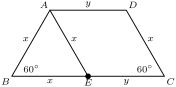
这是因为 \(\angle AEB = \angle DCB = 60^\circ\),所以三角形 \(ABE\) 是等边三角形。所有标为 \(x\) 的线段总是相等。
另外,\(ADCE\) 是平行四边形(不一定是菱形),所以其余标为 \(y\) 的线段彼此相等,但不一定等于 \(x\)。
周长为 \(3x + 2y\),题目要求它等于 \(30\)。
问题就变成数方程 \(3x + 2y = 30\) 有多少组正整数解。
考虑正整数 \(x\) 时,只有偶数值会给出整数 \(y\),因为 \(30 - 3x\) 必须是偶数 \(2y\)。
而当 \(x = 10\) 时,满足方程的 \(y\) 为 \(y = \frac{30 - 3 \times 10}{2} = 0\),不是正整数。
所以可行的 \(x\) 是小于 \(10\) 的正偶数,即 \(\{2, 4, 6, 8\}\)。共有 \(4\) 种,答案是 E。
English
Draw a line through \(A\) parallel to line \(CD,\) and observe that some lengths are automatically equal to each other:
That is because \(\angle AEB = \angle DCB = 60^\circ,\) and so triangle \(ABE\) is equilateral. All lengths labeled \(x\) are always equal.
Also, \(ADCE\) is a parallelogram (not necessarily a rhombus), so the remaining lengths labeled \(y\) are always equal to each other, but not necessarily equal to \(x.\)
The perimeter is \(3x + 2y,\) but it is also supposed to be \(30.\)
The problem then amounts to counting how many positive integer solutions there are to the equation \(3x + 2y = 30.\)
As we consider positive integers for \(x,\) observe that it is precisely the even integers which give an integer solution for \(y,\) because \(30 - 3x\) is the even number \(2y.\)
And, once we get to \(x = 10,\) the \(y\) that satisfies the equation is \(y = \frac{30 - 3 \times 10}{2} = 0,\) which is not a positive integer.
So, the values that work for \(x\) are the positive even integers less than \(10,\) or \(\{2, 4, 6, 8\}.\) There are \(4\) options, which gives the answer of E.
25 答案 B
设所求和为 \(X\)。
由对称性,如果改为求每条路径与左边界之间的面积和,结果也为 \(X\)。
但若把这个和与原来的答案相加,就等于对所有路径,把左侧面积与右侧面积之和全部相加。
对每一条路径,这两个面积之和正好是 \(25\)。
路径数等于重排 \(LLLLLRRRRR\) 的方式数,其中 \(L\) 表示向左,\(R\) 表示向右。重排数是 \(10\) 选 \(5\),记为 \(\binom{10}{5}\)。
所以 \(2X = 25 \times \binom{10}{5}\)。两边除以 \(2\),得到 \(X\) 等于 \[ \frac{10 \times 9 \times 8 \times 7 \times 6}{5 \times 4 \times 3 \times 2 \times 1} \times \frac{25}{2}\text{,}\]也就是 \(3150\),选 B。
English
Let \(X\) be the answer.
By symmetry, if the question asked for the sum of areas between each path and the left side of the grid, then the answer would be exactly the same \(X.\)
But if that answer is added to the original answer, that is exactly the same as the sum over all paths, of the sum of areas to the left and to the right.
For each path, that sum of areas is exactly \(25.\)
The number of paths is equal to the number of ways to rearrange \(LLLLLRRRRR,\) where \(L\) stands for left and \(R\) stands for right, as the path walks up. The number of rearrangements is \(10\) choose \(5,\) denoted \(\binom{10}{5}.\)
So, \(2X = 25 \times \binom{10}{5}.\) Dividing by \(2,\) we get that \(X\) equals \[ \frac{10 \times 9 \times 8 \times 7 \times 6}{5 \times 4 \times 3 \times 2 \times 1} \times \frac{25}{2}, \] which is \(3150,\) or choice B.